For several years, the Antietam Institute has been committed to supporting the Town of Sharpsburg in its efforts to develop an interpretive plaza in the green space at the corner of Main and Church Streets. Each year, we have made a $2,000 annual contribution for this project.
This year, construction on the park began in earnest, and by Memorial Day, 75% had been completed. The final piece of the park was the installation of interpretive waysides to tell the story of Sharpsburg and the people who have lived there.
Before the installation could begin, the waysides had to be developed. Because of our staunch support of the project since the beginning, the Sharpsburg Mayor and Town Council asked the Institute to help with this undertaking. After an initial concept meeting to develop some themes, we formed a committee of several members to begin formulating these themes and ideas into six distinctive waysides.
The committee included: John Schildt, Steve Cowie, Timothy Snyder, Robert Nill, Jim Buchanan, and Chris Vincent. The committee did an excellent job gathering stories, first-hand accounts, and photos for each panel. By July, the town approved the six draft panels, and they were off to Chris Brown, the Executive Director of Civil War Trails (CWT) for review and development. Civil War Trails, Inc. also collaborates with small parks, museums, and communities to share their history, topics, and sites by providing unique research and development expertise, along with high-quality materials.
To help draw interest to the historical park through the marketing of CWT, one of the six waysides was selected to be a Civil War Trails sign and the Antietam Institute took on the sponsorship and annual membership of that sign. This is the second CWT sign the Institute has sponsored in the Town of Sharpsburg.
Despite the frigid, wet weather, Chris Brown and his CWT crew installed the six waysides at the park the first week of December, just in time for the 35th Memorial Illumination.
The six waysides at the park are:
1- The Piper House: A Historic Connection to the Antietam Battlefield. Refers to the Piper house across the street, the Piper family, and the connection to the battlefield that so many Sharpsburg families had.
2- Canals and Turnpikes Fuel the Economic Growth. Discusses the C&O Canal and the turnpikes that intersect at Sharpsburg, which spurred economic growth of the town.
3- Sharpsburg Architecture and Prominent Citizens. Talks about some of the unique buildings in town and residents like Dr. A. A. Biggs, O.T. Reilly, and Dr. Hal Shealy.
4- Returning Veterans and Remembrance. Shows the connection between veterans returning to Sharpsburg after the war and the tradition of the Sharpsburg Memorial Day parade.
5- Sharpsburg and the Battle. Focuses on the civilians in town, specifically the Adam Michael family, whose house is across the street from the park, and the hardships caused. (Civil War Trails wayside)
6- Sharpsburg and the Civil War. Shares stories of several residents who were caught up in the war, like Barney Houser, Thomas Grove, Judge David Smith, and Jacob Rohrbach.
One final vertical interpretive panel will be added in the spring that will include the founding of the town in 1763 by Joseph Chapline, a timeline of key events, and a map of Sharpsburg. The Sharpsburg Historical Park is a much-needed resource to tell the amazing story of Sharpsburg and its residents and will help interpret this chapter of the Maryland Campaign and the Civil War.
We want to thank the committee members for sharing their time, effort, and knowledge on this project. Thanks to Chris Brown and Civil War Trails for their hard work and commitment in sharing the stories of civilians, soldiers, and communities. More importantly, we would like to thank the Town of Sharpsburg, Mayor Russ Weaver, and Vice Mayor Jacob Martz for the opportunity to support this project and promote the town’s history. We look forward to our continuing partnership with Civil War Trails and the Town of Sharpsburg.
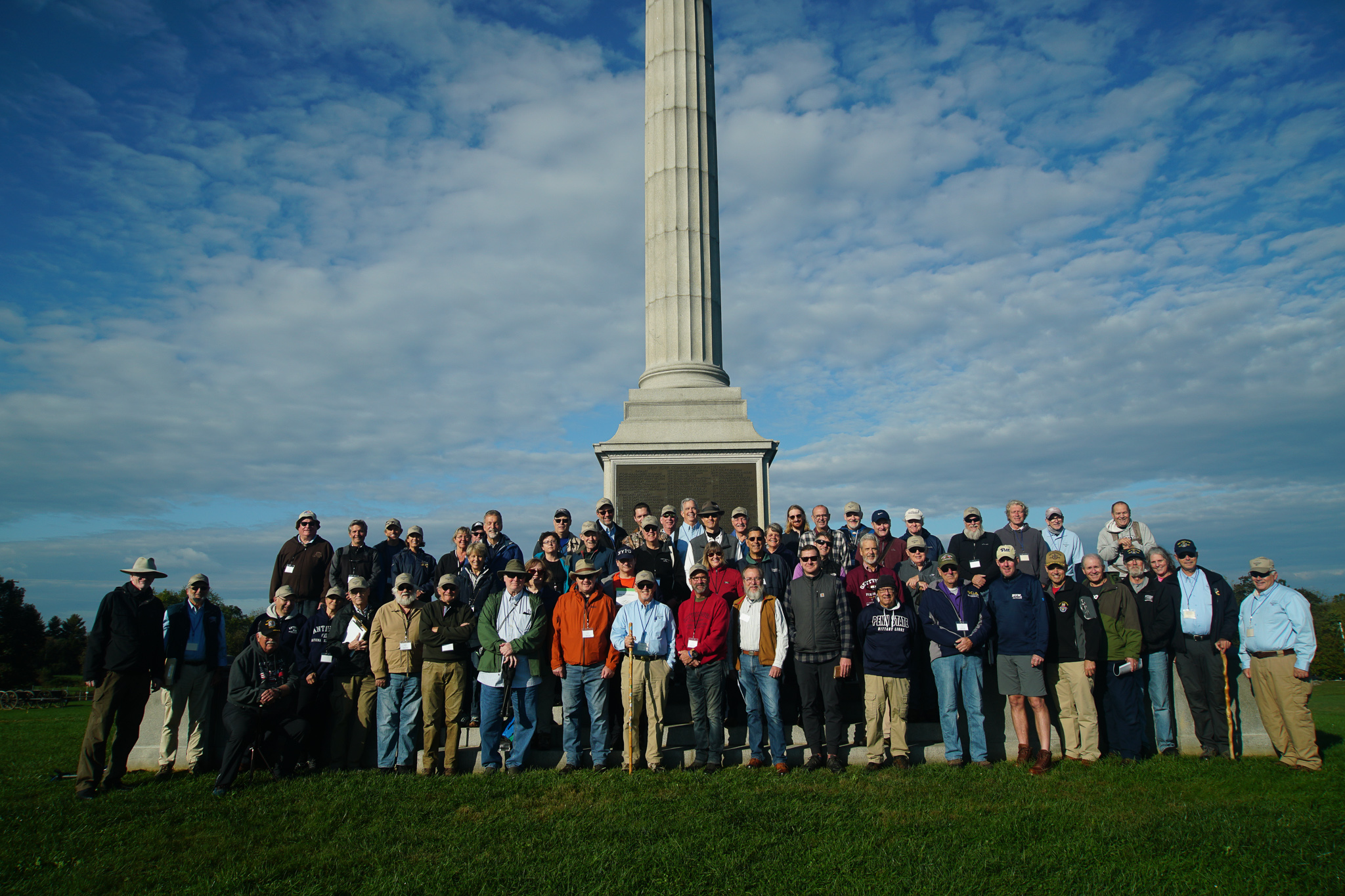
The 2025 Antietam Institute Fall Conference is in the books, and this year is one to remember. Taking place from October 3rd to the 5th, over 100 Institute members came out to learn, share knowledge, and network.
On Day One, we all came together at Shepherd University to hear four different lectures from some of the most sought-after and insightful voices from the Maryland Campaign community.
This year’s theme was “Beyond the Battle: Civilians, Casualties, and Remembering the Bloodiest Day in American History”.
Tracey McIntyre, Lead Educator with the National Museum of Civil War Medicine, kicked off the event with her presentation “One Vast Hospital”: The Advances of Medical Care Before and During the Maryland Campaign. (Click here or photo to watch the talk)
Next, author and historian Steven Stotelmyer discussed the casualties of the battle and how the army’s proximity in the following months affected the local community. Steve’s talk was called, “A Most Disagreeable Task: Burial of the Dead” (Click here or photo to watch the talk)
Due to a last-minute cancellation, renowned historian John Schildt was asked to fill in for the scheduled speaker. With less than two days to prepare, John thrilled the audience with a first-person account of Abraham Lincoln’s visit to Sharpsburg after the battle of Antietam. What a legend. Thank you for stepping up to help John by presenting “Lincoln’s visits Antietam”. (Click here or the photo to watch the talk)
After dinner, it was time for the keynote speaker of the event. Author and historian Steve Cowie presented a point of view of the battle from the perspective of the families who lived on what would become the battlefield of Antietam. These stories of hardship, loss, and terror really summed up the overall theme of the event and brought home to all of those who were in attendance the cost of war for not only the soldiers who fought and died, but the American families who hosted these battles and lost everything in the process. (Click here or photo to watch the talk)
DAY 2 The speakers from Day One left everyone excited for the next two days of traveling the battlefield and surrounding areas. With the theme of the event being casualties and civilians, Days Two and Three focused on hospitals, homesteads, and headquarters. Members were split into three groups, with Chris Vincent, Dr. Tom Clemens, and Dana Shoaf taking turns to show each group various places in and around Sharpsburg.
“Courage Under Fire: The Impact of Antietam on the Civilians of Sharpsburg” – Dr. Tom Clemens, president of the Save Historic Antietam Foundation (SHAF) walked the group around Sharpsburg, giving insightful information on some of the important buildings in town and discussing SHAF and their preservation efforts. This included a walkthrough of historic structures that the general public does not have access to.
One of the highlights of the Sharpsburg tour for me personally was the Kretzer cellar, where at least 75 people hid during the battle for safety. Theresa Kretzer hid in this cellar with her family and other members of the community, and more importantly, she wrote about the experience so we could all have a record of events on the day of the battle from a non-military perspective.
This was a wonderful opportunity for Institute members to see what they are helping to preserve. Thank you to Tom and the wonderful people at SHAF for their support.
“Ravages of War: Farmsteads of Antietam” – Next, Antietam Institute Executive Director Chris Vincent took the groups on a tour of the homesteads that dot the battlefield. These stops included the Joseph Poffenberger Farm, the Roulette Farm, the Piper Farm, and the Mumma Farm. Chris provided insight into the history and hardships that these families had to endure during and after the battle. It was a real eye-opener. Thank you, Chris,
“”Thousands of poor, suffering dying men”: Hospitals of Antietam” – Last but not least, Dana Shoaf, Director of Interpretation at the National Museum of Civil War Medicine, led the groups to the various Union hospitals that popped up all around the area in the wake of this terrible battle. Starting with Locust Spring Hospital, which was a Ninth Corps Hospital after the battle, and a rare treat for most of the group, since this location is on private property.
Next, we were off to the Samuel Pry Mill, which served as one of the earliest field hospitals during the battle.
Our last stop of the day was a real treat as the Institute was granted access to the Jacob Cost Farm. This is quite possibly the first field hospital during the battle where the first amputation of the battle is said to have happened. The owner of this private property was generous enough to allow us access to the inside of his home, which was a wonderful example of preservation. Even the old smokehouse is preserved along with the turnstile used to rotate the smoked meats.
Both the Pry Mill and the Cost Farm are north of the battlefield near the Upper Bridge, where the First and Twelfth Corps crossed the Antietam on the 16th of September 1862.
After meeting for dinner back at Shepherd, the group had a special presentation as retired Park Ranger Keith Snyder gave our members an exciting behind-the-scenes look at the making of the new Antietam Visitor Center film that he helped to create. Thanks Keith.
DAY 3 Day Three saw more gorgeous weather in western Maryland and more field excursions. The group met at Ferry Hill, the childhood home of Henry Kidd Douglas, and was split in half and divided our time between Dennis Fry and Kevin Pawlak.
“Following Lincoln’s Footsteps” – Dennis Frye, retire NPS historian took the group on a tour of the army headquarters for the Army of the Potomac in Maryland after the battle, and discussed President Abraham Lincoln’s visit to the area days after signing the preliminary Emancipation Proclamation. Starting at the Grove Farm. This was the headquarters of Fritz John Porter, of the Fifth Corps after the battle. The famous photo showing Lincoln with his officers was taken here.
Next, we were off to General Burnside’s Headquarters immediately following the battle. President Lincoln paid a visit to General Burnside at this house in early October 1862.
If you are going to visit General Burnside’s Headquarters, you have to see General McClellan’s Headquarters while you are in the area, so Dennis took us to the site where the famous photo of Lincoln and McClellan in the General’s tent was photographed.
“Shepherdstown: One Vast Hospital” – After touring around with Dennis, the groups swapped guides, and Kevin Pawlak took us on a tour of Shepherdstown. This tour took the group on a walking trail around Shepherdstown, where Kevin pointed out all of the buildings in town that were temporarily used as Confederate hospitals following the battle.
After three days of fantastic presentations, guided tours under amazing weather, and access to buildings rarely seen by the public, it was time to say goodbye and end the Fall Conference.
We did have a chance to talk to a few of the members to get their thoughts on the conference and what they enjoyed about it. Thanks to members William Brian, Paige Troiano, Will Blaney, Michael Diener and Ricardo Valdez for a quick interview.
Everyone was tired, but happy, with smiles all around. With the exchange of hugs, handshakes, and promises to see each other again soon, we departed the event with a new understanding and appreciation for Sharpsburg and its citizens during the Bloodiest Day in American History. Thank you to the Antietam Institute for letting me tag along.
All the locations visited off the Antietam National Battlefield are privately owned. We want to thank each of the property owners for allowing the Antietam Institute to share the story of the civilians and the hardships they faced after the bloodiest day in American history.
This review, the photos, and the videos of the Fall Conference were provided by Institute member Ernie Chase.
Ernest Chase (Ernie) is a commercial trainer in the heating and cooling industry, having travelled to 49 states and three countries over his 31-year career. He continues to instruct technicians in Maryland and the surrounding area, having moved to Sharpsburg in 2024. Ernie is an amateur historian and is actively learning from those who know the Maryland campaign inside and out. He joined the institute in 2024 and volunteers his spare time as a filmographer, helping to bring what we do to remote audiences who could not personally attend our events.