
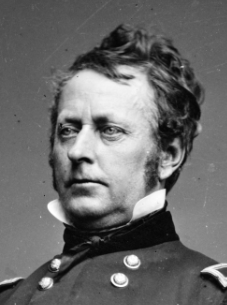
Position at Antietam
Commander, First Corps, Army of the Potomac (Age 47 at the battle)
Personal
1814-1879 Massachusetts
Nickname: Fighting Joe
Born in Hadley, Massachusetts. Son of Joseph Hooker, a dry goods merchant; Bachelor until 1865 when he married Olivia Groesbeck, sister of Ohio congressman, in 1865. She died three years later. No children
Education
West Point Class of 1837, ranked 29th of 50; Classmates: Braxton Bragg, Jubal Early, William French, John Sedgwick. Commissioned in the First Artillery.
Mexican War
Served as an assistant adjutant general or aide de camp to various generals. Was the only lieutenant in the war to be awarded three brevets for gallantry (Monterrey, National Bridge and Chapultepec).
Other military career highlights
Adjutant of the First Artillery regiment, 1841-1846; Transferred to Adjutant General’s Department after the Mexican War and held administrative positions on the west coast until his resignation from the army in 1853. Colonel in the California militia from 1859-1861.
Civilian career highlights
Farmer in Sonoma California, 1853-1858, and Superintendent of Military Roads in Oregon from 1858-1861. Short of money when the war started, a friend loaned him $1,000 so that he could sail to the east coast and obtain a commission
Civil War
Personally appealed to President Lincoln for a commission when the War Department ignored his requests. Brigadier General May 1861; brigade and then division commander in the Third Corps, Army of the Potomac; fought on the Peninsula Campaign at Williamsburg in May and in the Seven Days Battles in June. Fought at Second Manassas in command of his division; elevated to command of First Corps, Army of the Potomac, in September 1862; led the corps at Antietam where he was wounded in the foot. Commanded Center Grand Division at Fredericksburg in December, 1862; appointed commander Army of the Potomac January 26, Instituted important reforms: furlough policy, improved food, reorganized cavalry, corps and division badges. Defeated by Lee at Chancellorsville, spring of 1863. Requested to be relieved of command of the Army of the Potomac on June 28, 1864; Commanded Twentieth Corps, Army of the Cumberland, in Tennessee Campaigns and in Atlanta Campaign; Relieved of command July 30, 1864; Commanded Northern Department at Cincinnati until July 1865.
Postwar
Remained in the army in various department commands until his retirement for disability in October 1868
Death
Died suddenly on October 31, 1879 at age 64
Quotes
“Tomorrow we fight the battle that will decide the fate of the Republic.” Joe Hooker on September 16, 1862, on the eve of the Battle of Antietam
“We had not proceeded far before I discovered that a heavy force of the enemy had taken possession of a cornfield, a thirty-acre field in my immediate front.” Joseph Hooker reporting on the Battle of Antietam
“Hooker will however soon bring them out of the kinks and make them fight if anyone can.” George B. McClellan on concerns of the state of the First Corps
“Joe Hooker fed his men the best, and fought them the best, of any of the corps commanders.” William Hinckley, 3rd Wisconsin
“I was at the battle of Bull Run the other day, and it is neither vanity or boasting in me to declare that I am a damned sight better General than you, Sir, had on that field.” Joe Hooker to President Lincoln, August 1861
“The Army ran like sheep, all but General Hooker.” Phil Kearney, Sep 1, 1862
“At Chattanooga, his achievement … was brilliant. I nevertheless regarded him as a dangerous man. He was not subordinate to his superiors. He was ambitious to the extent of caring nothing for the rights of others.” U.S. Grant
“You are ambitious, which, within reasonable bounds, does good rather than harm.” Lincoln in Letter to Hooker
“As a corps commander with his whole force operating under his own eye, it is much to be doubted whether Hooker had a superior in the army.” John Pope