
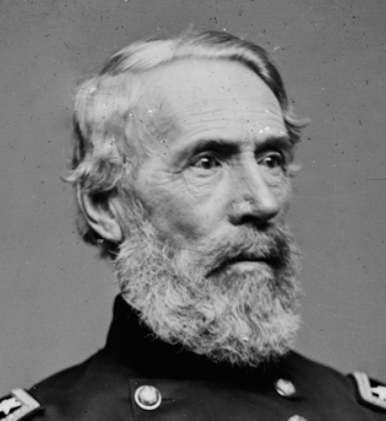
Position at Antietam
Commander, Second Corps, Army of the Potomac (Age 65 at the battle)
Personal
1797-1863 Massachusetts
Nickname: Old Bull Head
Born in Boston, Massachusetts. Son of Elisha and Nancy Vose Sumner. Married Hannah Foster in Six children: Nancy, Margaret, Sarah, Mary, Edwin, and Samuel (both sons were generals in the Spanish American War)
Education
Milton Academy in Milton, Massachusetts. After losing interest in the mercantile business, entered the U.S. Army as a second lieutenant in the Second Infantry in 1819. Later transferred to the First Dragoons.
Mexican War
Major in the Second Dragoons, brevetted twice for gallantry at Cerro Gordo & Molino del Rey
Other military career highlights
Black Hawk War and various Indian campaigns before Mexican War; commanded Cavalry School, 1838. Military Governor of New Mexico, 1851-1853. Promoted to Colonel, First Cavalry in 1855 (one of his lieutenants was JEB Stuart), in Kansas during violent ‘Bleeding Kansas’ era; Led campaign against the Cheyenne Indians; Commanded Department of the West, 1858-1860, and Department of the Pacific, 1861
Civilian career highlights
N/A
Civil War
Promoted Brig. Gen. U.S. Army in March 1861; returned to Washington in November 1861. Division commander, Army of the Potomac, Second Corps (March 1862); led Second Corps at Williamsburg, Fair Oaks, and Glendale, where slightly wounded; Led Second Corps in Maryland Campaign and Battle of Antietam. Commanded the Right Grand Division at Fredericksburg; requested to be relieved of command when Hooker was appointed to command the Army of the Potomac.
Postwar
N/A
Death
Died of fever and exhaustion in Syracuse, NY, March 21, 1863, age 66.
Quotes
He was of the old school, rugged and stern, honest and brave. He detested frivolity, was austerely sober, and always reminded me of Cromwell’s best puritan soldiers.” Thomas Claiborne
“Never say ‘go in,’ Mr. Lomax, but ‘come in.’” Edwin Sumner
“The commander himself was of racehorse stock; he ran until he dropped; and he expected no less from every man of his raw troops.” Francis Walker
“Old Man Sumner goes to the front, look out for a fight.” A common saying in the Second Corps
“In God’s name, what are you fighting for? Unfurl those colors!” Sumner to the 1st MN in the West Woods at Antietam
“[Sumner] proved that he was even a greater fool than I had supposed.” George B. McClellan (after the Battle of Williamsburg May 5, 1862)
“He displayed the utmost energy in bringing his troops into action & handled them with the utmost courage in action. He repulsed every attack of the enemy & drove him wherever he could get at him.” George B. McClellan after the battle of Fair Oaks May 31, 1862
“He has neither capacity, nor sane judgement. He is a proverbial blunderer.” Phil Kearney
“Go back, young man, and tell General McClellan I have no command. Tell him my command, Bank’s command and Hooker’s command are all cut up and demoralized. Tell him General Franklin has the only organized command on this part of the field.” Sumner to Lieutenant Wilson describing the situation on the Union right at Antietam
“Keeping all near him steady.” Describing the calming effects of Sumner on the men of the 59th NY and 20th Mass in the West Woods at Antietam