
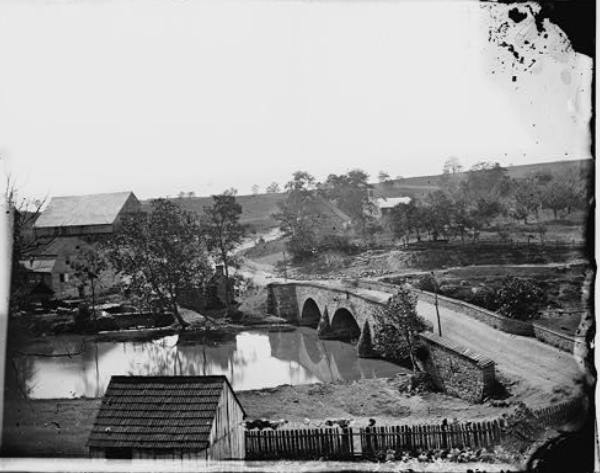
Joshua Newcomer farm at the Middle Bridge, c. 1862
Position at Antietam
Civilian farmers (Joshua – Age 53 and Mary Ann – 49 at the battle)
Family and Farm
- Joshua and Mary Ann (Ankeney) Newcomer (m. 1837)
- Seven children 13 to 24 years of age in 1862; 6 of 7 were at home.
- Farm – 152 acres, valued at $11,000. Grew apples, peaches and all kinds of fruit in 20-acre orchard. Half of the Newcomer farm (77 acres) was clover and timothy pasture in September 1862
- The farm had a variety of livestock, such as horses, milk cows, cattle, sheep, swine, chickens, geese, and turkeys.
- The Newcomer family went to Keedysville (initially to the Pry’s) for safety on the 15th of September
- Daniel B. Grim resided at the toll house and witnessed Federal soldiers taking Newcomer’s crops and livestock.
- Private John Clinton Newcomer, 20, joined the Confederate army’s Purcell (Virginia) Artillery in June 1862. He was killed at Fredericksburg in December 1862. Joseph Hooker wrote R.E. Lee from Falmouth, VA on March 7, 1863, “I will have an officer ready on Monday, the 9th instant, to receive the body of J.C. Newcomer, killed in the engagement at Fredericksburg December 13, 1862, and which I have learned you have authorized to be sent across the river.”
Historical ownership and Structural Changes
- 1756 James Smith (Resurvey of Smiths Hills); a road & ford is built through the property
- 1762 Christian Orndorff; builds large three-story home, barn, grist mill, a sawmill, and a plaster mill along Antietam. Property stays in the family, milling operations expanded in the 1780’s. A miller house is built on east side of creek and another dwelling house (current house) is built. Adds several workshops and a cooper shop.
- 1796 Jacob Mumma purchased 324 ¼ acres from Christopher Orndorff (this included Parks farm). Property stays in the Mumma family, changing hands among the sons.
1824 Silas Harry builds a three-arched stone bridge over the Antietam (Orndorff bridge)/1833 turnpike complete
1841 Jacob & John Emmert purchase 152 acres, partnership short lived sold in 1846 to Jacob Miller
1848 Lewis Watson, partner is Joshua Newcomer
1854 Joshua Newcomer
1866 Jacob Myers & Frederick Miller, by 1880 milling industry in decline
1889 Dam washes away due to Johnstown Flood, bridge collapsed and replaced
1901 Jacob Myers died; property changes hand several times over next century/1954 Rt 34
1999 William Chaney – restored house intending to run a museum and place monuments
2003 NPS acquired the barn in 2003, restored in 2014. NPS purchased the structure in 2007 / 2010, HCWHA
Battle of Antietam
- Colonel Edward E. Cross ordered two companies from the 5th New Hampshire to destroy the Newcomers’ mill-dam, “which backed up the waters of the creek.”
- Union troops recon across the bridge on the morning of September 16th and push to high ground on both sides of the pike.
- On the 17th, Pleasanton’s Cavalry Division and Horse Artillery occupy the property. Union infantry (Regulars) come across to support the artillery and push toward Sharpsburg.
Aftermath
- 8th Pennsylvania Cavalry reportedly bivouacked; officers boarded at house; 3 to 4 weeks
- Battery B/Rhode Island Light Artillery confiscated 900 bushels of corn
- Newcomer lost 67 of his animals after the battle, comprised of 42 hogs and 25 shoats; also twelve turkeys and “200 chickens of large size, 3 or 4 acres of potatoes, 6 beehives filled with bees & honey, three barrels of cider vinegar”
- He claimed $15 for “Damages done to dwelling house by Shells and Rifle and Musket balls” and $40 for “Furniture in dwelling house destroyed or damaged by shells.” Newcomer also claimed $25 in “Damage done to Mill House, barn and [cooper]shop by balls and shells.” $350 in reparations for his mill’s dam and race.
- 4,964 fence rails, 28 panels of board fence, 42 panels of board fence 16 feet long, 1 sorrel horse, 18 acres of corn and fodder, and the uncut hay on 77 acres of pastureland.
- Troops took $3,097.15 worth of supplies in September and October 1862.
- According to one witness, Newcomer “also suffered a heavy loss at the hands of the Rebels, including a large quantity of flour, horses, cattle, etc., amounting to about eleven thousand dollars.”
- The Court of Claims awarded Newcomer $880 for his Bowman Act case but did not pay the settlement until 1899.
Postwar
- Jonathan Keplinger, 48-year old cooper, his wife, and nine children tenanted a home on the Newcomer farm. In March 1863, Keplinger was killed while removing unexploded artillery projectiles out of the fields.
- Unable to operate after the battle, the mill was turned into a hospital. Newcomer, staggered by wartime debt, sold his real estate and moved his family to Ogle County, Illinois in 1868.
- He moved back to Clear Spring, MD before 1880.
Death
In August 1887, Mary Ann, 73 years old, passed away, followed by Joshua just four months later in December at the age of 78. They are buried in Saint Paul’s Lutheran Church Cemetery in Clear Spring, Maryland.
Quotes
Joshua Newcomer wrote in his claim, “On or about 17th day of September 1862 a portion of the U.S. (Army) under the command of General Porter (V Corps) encamped on and near said farm, and on the four days immediately succeeding said battle appropriated for their immediate use a large quantity of his property including 4,964 fence rails, 28 panels of board fence, 42 panels of board fence 16 feet long, 1 sorrel horse, 18 acres of corn and fodder, and the uncut hay on 77 acres of pasture land.”
Joshua Newcomer filed a claim for “Stonepicks, mattock, shovels used by the Union troops to bury the dead.” Newcomer’s son, William, testified that his father’s implements were “used in burying the dead, and that was the last he saw of them.”
Isaac Newcomer, a son of Joshua Newcomer, recalled that after the battle, “[T]here were a number of officers boarding at his father’s house . . . among them were Majors, captains, lieutenants, and there may have been colonels.”
Josephine Newcomer Miller, attested that Federals occupied her parents’ farm “for 3 or 4 weeks . . . there was a great number of them encamped on the farm.” “One was Major Keenan,” Josephine recalled. “These officers were back and forth from the house. They took their meals three times a day at my father’s house.” Josephine also recalled, “I was out on the farm on one occasion and saw the [AOP] camp fires and other fires going and saw when the rails had been taken.”