
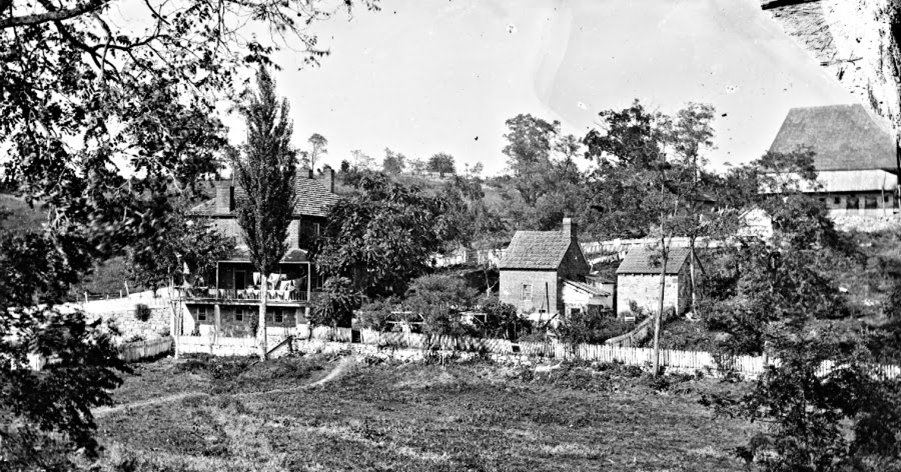
Joseph Sherrick’s house, c. 1862
Position at Antietam
Civilian farmers (Joseph – Age 60 and Sarah – 55 at the battle)
Family and Farm
- Joseph Jr. and Sarah (Hamm) Sherrick (m. 1828)
- Sherricks & Mummas were very good friends. Joseph Sr. married Barbara Mumma, Jacob Mumma’s sister after his first wife died.
- 1858, Mary Anna Sherrick (daughter) married Victor Newcomer.
- Greek Revival style home built terraced over a spring. The interior stairs & baseboard were marbleized, along with the doors and floor painted to gave an impression that the family was more affluent.
- Farm – @ 250 acres, 38-acre cornfield, 2-acre orchard “the farm consisted of 200 improved acres and 20 unimproved acres and was valued at $14,000. Livestock was valued at $500. During the year ending that June, the farm produced 1,500 bushels of wheat, 20 bushels of rye, 1,000 bushels of Indian corn, 150 bushels of oats, 100 pounds of wool, 50 bushels of potatoes, $20 in orchard products, 500 pounds of butter, 25 tons of hay, and 12 bushels of clover seed.”
- 1860 census, Ellan Ward, young female servant and Samuel Gift, a farm hand.
- Leonard Emmert, his wife Sarah and 5 y/o daughter Susan lived in a tenant house 1860-63; the Sherricks moved to Boonsboro soon after the battle to live with daughter & son-in-law.
Historical ownership and Structural Changes
- 1756 James Smith granted land patent Smith’s Hills
- 1762 Christian Orndorff. Log or frame home structure built
- 1795 Joseph Sherrick, Sr. purchases 196 acres. Barn built 1790-1800, stone smokehouse
- 1836 a three-arched stone bridge built across the Antietam. Sherrick constructs stone fence on east side of creek
- 1838 Joseph Sherrick, Jr acquires father’s property. Replaces wooden structure with new Greek revival style brick home
- 1862-1925 property stayed in the Sherrick-Newcomer family. Parcels sold to veteran’s assoc. and Federal Gov’t.
- 1925 James Dorsey
- 1964 NPS purchased 186-arce Dorsey tract. Following year Burnside Bridge Bypass Road. The barn caught fire on the night of June 18-19, 1985, and was destroyed.
Battle of Antietam
- Local lore from O.T. Reiley – Joseph Sherrick hid gold in his farm’s stone wall before evacuating the Sharpsburg farm prior to the battle.
- Willcox’s division moves across the farm on their advance toward Sharpsburg. They push to the outskirts of town and are forced to withdraw back to the banks of the Antietam.
- On the far left of the Union Ninth Corps line, the 16th Connecticut & 4the Rhode Island are overwhelmed by Confederates from A.P. Hill’s Light Division in Sherrick’s cornfield.
- Pvt R.G. Carter, 22nd Massachusetts witnessed the scene at the Sherrick house: “Upon visiting Sherrick’s house this morning, we found it quite a sumptuous affair. It had been hastily evacuated, as it was between the lines. The foragers ahead of us had pulled out what edibles it contained, and among them a splendid assortment of jellies, preserves, etc., the pride of every Maryland woman’s heart, but now scattered all about. The orchard was filled with the choicest fruit. What a feast!”
Aftermath
- The Union Army displaced the Emmert family for nearly a month. Used as hospital, “Dr. Elisha Harris stated at the time of his visit 85 soldiers were treated at the Sherrick and Otto houses, with a capacity for 104.”
- Combat destroyed some of the crop including the 38-acre cornfield. Afterward, Army of the Potomac troops seized the remainder of corn as horse forage “until the whole field was stripped.”
- Emmert returned home two days after the battle. His cow and mare died during the battle. There was damage to the garden and soldiers confiscated vegetables. Furniture damaged, loss of soap, vinegar, tallow, set of dishes and china. “Queensware & stoneware.”
- Sherrick reported a loss of 30 jars of fruit, 25 glasses of preserves, 50 pounds of sugar, and 200 pounds of bacon.
- Joseph Sherrick claimed damage to his home of $8 from an artillery shell.
- Of Sherrick’s $1136.50 claim, Congress authorized a $582.00 Treasury settlement to “Victor Newcomer, administrator of Joseph Sherrick, deceased.”
- Mumma family will reside at farm until their home was rebuilt in June 1863.
Postwar
- Joseph’s son-in-law, Victor Newcomer, inherited the farm and continued to seek compensation from the government, but he received very little.
- Sections of the land were sold to veterans’ associations for the placement of monuments and to the federal government for preservation.
- In 1925 the property was purchased by James A. Dorsey. The property stayed in the Dorsey family until 1964 when the 186-acre Sherrick farm (known as the Dorsey tract) was sold to the National Park Service.
- As part of the Mission 66 project in 1965, work began on the Burnside Bridge Bypass Road redirecting local traffic past the Sherrick farm and off the lower bridge.
Death
Joseph Sherrick Jr died on Aug. 10, 1871. Almost three years to the day, Sarah passed away in 1874. Joseph and Sarah Sherrick are buried in the Mumma Cemetery with Joseph’s parents and their friends the Mummas.
Quotes
Leonard Emmert testified, “were hauling and carrying it away for several days until the whole field was stripped.” He also stated he “did not get any of this corn except for a wagon load with husks on, which he fed to the pigs.”