
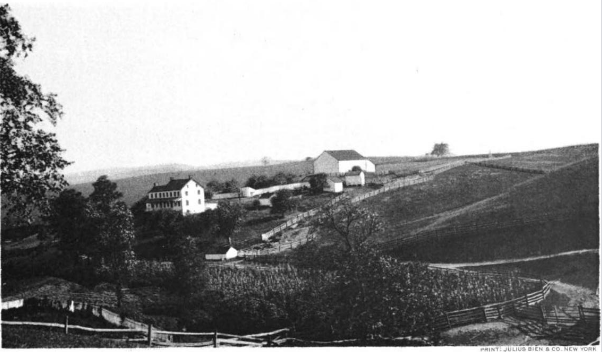
John Otto farm, c. 1900
Position at Antietam
Civilian farmers (John – Age 59 and Catherine – 56 at the battle)
Family and Farm
- John and Catherine (Gardnouer) Otto (m. 1849)
- John’s first wife, Dorcas Miller (M. 1825, d. 1844) had six children. Mary Ann (35) and Daniel (22) lliving at home. David F. Otto; Ann Catherine Otto Cox, (William I. Cox); John Miller Otto (married, moved to Illinois), Joseph Henry Otto.
- Farm – @ 67 improved acres and 36 unimproved acres. The farm was valued at $4,000, and his livestock was valued at $500. The farm produced 800 bushels of wheat, 100 bushels of rye, 400 bushels of Indian corn, 70 pounds of wool, 20 bushels of potatoes, $25 of orchard products, 500 pounds of butter, 15 tons of hay, and 12 bushels of clover seed in 1860.
- The family owned two individuals, Nancy Watson and her son Hillary Watson.
- John Otto owned the 67-acre farm near Burnside Bridge, as well as a 126-acre farm adjoining Miller’s Sawmill Road and a 132-acre tract adjoining the Showman family’s Home farm, southwest of Sharpsburg.
- The Ottos may have gone to the farm tenanted by son David along the Miller Sawmill Road for safety during the battle.
Historical ownership and Structural Changes
- 1763 Joseph Chapline
- 1769 Joseph Chapline Jr. acquires property after his father’s death
- 1815 Peter Ham
- 1831 John Otto purchases 66 acres and Joseph Sherrick purchases 66 acres of the farm
- 1865 David Otto takes over farming operations after his father retires to Sharpsburg
- 1870 Jacob B. Stine
- 1891 Stine purchases the other half of original farm
- 1908 James & Susan Dorsey
- 1968 Paul and Twila Shade
- 1971 Charles and Orpha Mae Kauffman purchase the 2+ acres of farm buildings
- 1976 National Park Foundation the 2+ acres
- 1984 NPS acquires the 2+ acres
- 2003 NPS acquires the remaining parcels of the Otto and Sherrick farmland
Battle of Antietam
- Hilary Watson: “The hill at our place was covered with ’em [Confederates]. They’d walk right into the house and say, ‘Have you got anything to eat?’ like they was half starved. We’d hardly fix up for a couple when a lot mo’ would come in.”
- Hillary remained on the property to guard horses but evacuated when the shelling intensified, “I didn’t like those shells a-flyin’, and I got on one of the horses and led some of the others and went off across the Potomac to the place of a man who was a friend of my boss. There I stayed all day listenin’ to the cannon.”
- Willcox’s Ninth Corps Division advanced across farm during the final attack. Clark & Durrell’s artillery was positioned on high ground south of the farm; Sturgis’ division reinforced the Union line on the farm during the Confederate counter-attack.
Aftermath
- One Union soldier, William Mitchel of the 9th New York had engraved his name and unit in a windowsill in an upstairs bedroom of the Otto house.
- John Otto delivered his rye harvest to a nearby gristmill before the battle, intending to pick up the ground meal later. Instead, to Otto’s dismay, soldiers confiscated his rye as “forage for the army horses.” “[O]ne hundred bushels of old corn . . . was stored in my barn on the farm at Burnside Bridge, and was taken for the use of and was consumed by the army animals.”
- Thirteen cords of wood “was cut and seasoned and was piled in my yard for winter use.” After the battle, though, Otto’s firewood “was burned for fuel in the Hospital and by soldiers around my house.”
Postwar
- In 1873, Otto filed a claim for $2350.60, but he would only receive $893.85 for his losses.
- John Otto retired from farming leaving the tending of the farm to his son. He moved into Sharpsburg where his second wife Catherine died in 1867.
- After Catherine’s death, John Otto made his home with his son David on Antietam Street in Sharpsburg.
- Hillary Watson was married to Christina Watson, enslaved cook owned by Jacob H. Grove at the town square.
Death
Catherine died August 13, 1867, age 62. John died on December 8, 1884. John and both his wives are buried in the Mount Calvary Lutheran Cemetery in Sharpsburg.
Quotes
John Otto would write, “My House, Barn, and Granary were taken possession of September 17th and used for Hospital purposes til the 4th of Nov. 1862, during which time everything in and around it that could be of any service, was taken and used, including Beds, Furniture, Commissary stores, condiments and anything that would contribute to the comfort of the wounded, being either consumed entirely or rendered unfit for further use. The surgeons in charge at my house was I think, Dr. Warren and Dr. McDonald.”
John Otto testified, “[O]ne hundred bushels of old corn . . . was stored in my barn on the farm at Burnside Bridge, and was taken for the use of and was consumed by the army animals.”