
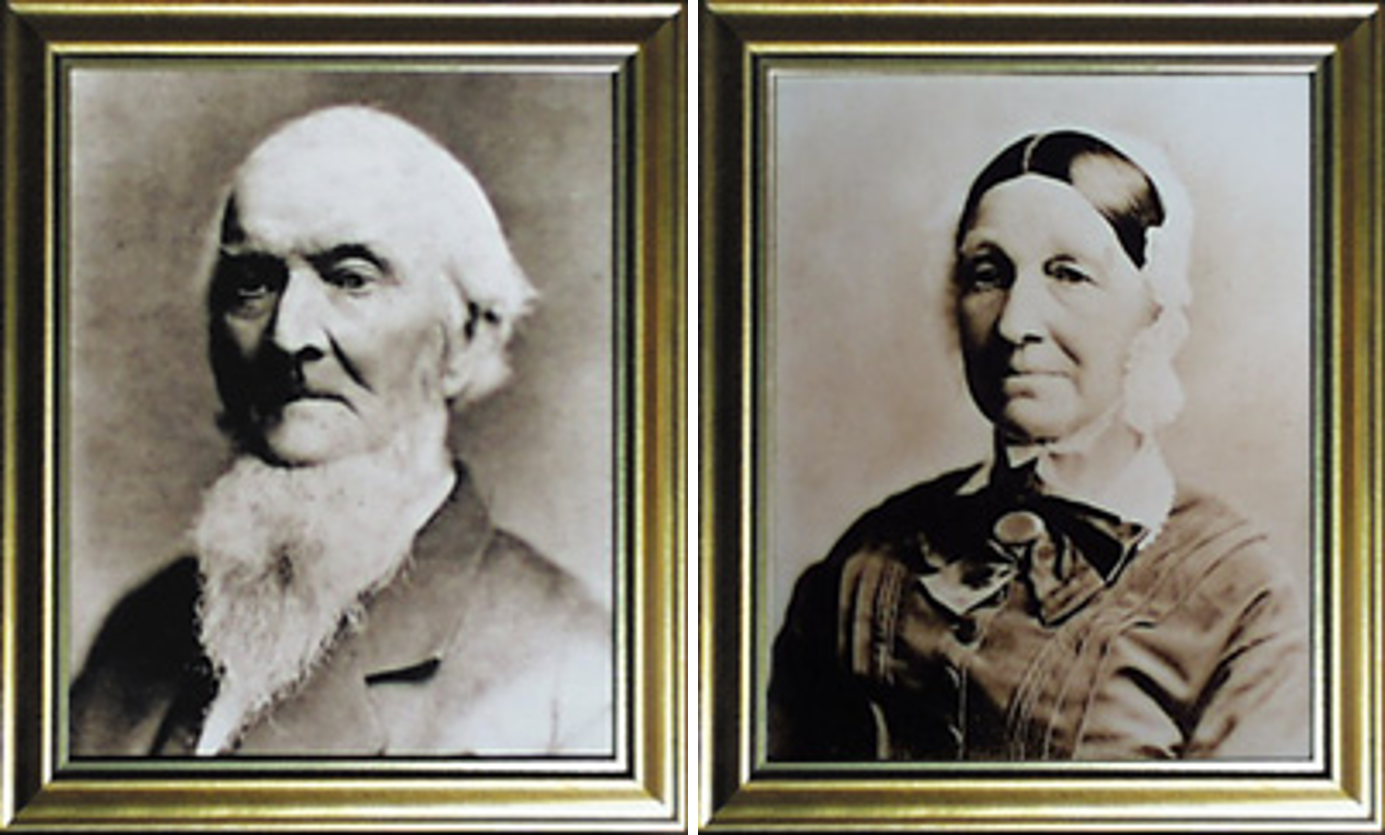
Henry and Elizabeth Piper
Position at Antietam
Civilian farmers (Henry – Age 53 and Elizabeth – 52 at the battle)
Family and Farm
- Henry and Elizabeth (Keedy) Piper (m. 1828)
- Had five children spanning from 17 to 33 years old (three other children died before the war). The two youngest kids lived at home: sisters Mary Ellen, age 21, and Susan, 17. The other three Piper children – Barbara (Cost), Samuel D. Piper, and Elizabeth (Showman) — resided in the area with their spouses and children.
- Farm – 194 acres, valued at $11,000. 17-acre apple orchard, 25 acres of corn.
- The farm had a variety of livestock, such as horses, milk cows, beef cattle, sheep, swine, chickens, geese, and turkeys.
- Slave owner – In 1860, Henry owned six slaves, five of them children, one of the slaves on the farm in 1862 was Jeremiah (Jerry) Cornelius Summers. He was born on the farm in 1849.
- 1860 census – 16-year-old free black farm hand named John Jumper worked on the farm.
Historical ownership and Structural Changes
- 1790 Joseph Chapline, Jr. inherits land from father including Elswick’s Dwelling; believe property had been cultivated since 1740, two cabins on land, possibly summer kitchen/slave quarters was one.
- ???? (before 1803) John Miller
- 1821 Jacob Miller (son) built the icehouse/cavehouse and bank barn; rented farm to tenants
- 1846 Daniel Piper (Henry had moved to farm as tenant in 1843)
- 1857 Henry Piper acquired after Daniel Piper’s death
- 1863 Samuel D. Piper took over farm (purchased in 1890) / 1912 Elmer E. Piper / 1933 Samuel Webster Piper
- first floor of the wing (15 by 15 feet) was added around 1898, and the second story of the wing was added in 1912, wooden addition to barn in 1914
- 1960 Purchased by the Antietam-Sharpsburg Museum, Inc.
- 1964 Sold to the National Park Service (NPS) for $75,000
- 1985 Doug Reed took a 56-yr lease to restore the house and use it as a B&B.
- 2019 Lou & Regina Clark, the last residents of the house move out and the NPS will end the lease.
Battle of Antietam
- Confederate Generals James Longstreet and D.H. Hill had arrived and chose to use the Piper house as their headquarters starting on September 15. The Pipers fed hungry Rebels and their generals.
- The family went to the brother Samuel I. Piper’s farm three miles northwest for safety on September 15th.
- Rebel infantry were posted along the Sunken Road and artillery on the high ground across the farm.
- Nearly 17,000 men engaged in the three-hour struggle in and around the Sunken Road, 5,500 were killed, wounded, or missing.
Aftermath
- $25 was paid for “Damage to Home & Barn”, “only one room in the house that a cannon ball had not penetrated;”
- “What a sight met my gaze. The room was full of dead men! Pools of blood were standing on the floor. I only looked one glance and passed on.” Among the corpses in Piper’s house were “three dead rebels, one of whom had crawled under the piano to die.”
- Piper later amended his initial claim to $2,488.85
- Blankets, cloth, curtains taken and used for the wounded. Pipers volunteered to help the wounded in the hospitals.
- “ate two hundred of Piper’s chickens, fifteen geese, along with twenty-four turkeys”. They also took “one hundred bushels of Irish potatoes, thirty bushels of sweet potatoes,… six barrels of vinegar, eight hundred pounds of bacon, five sacks of salt, four bushels of onions, pickles, one bushel of dried cherries, two hundred bushels of apples, six gallons of cherry wine, and one hundred and ten jars of fruit. They took thirty dollars worth of men’s clothing, and sixty dollars worth of lady’s clothing”
- Roan mare, Diamond, worth $200 taken by Union forces
- They lost 25 pounds of soap
- Dr. Biggs logged thirteen house calls to Henry Piper’s farm from September 27–December 7. At least one appointment involved Henry’s wife, Elizabeth. The doctor primarily medicated the Pipers with opium and calomel for ten weeks, suggesting that diarrhea or dysentery may have sickened the family.
- Barbara Ann (Piper) Cost died in Februry 1863 / Elizabeth (Piper) Showman’s husband, Raleigh died in April 1863.
Postwar
- In 1863, Henry and Betsy moved into Sharpsburg to the house that Henry acquired in 1857 following his father death. The house sits on the corner of Main and Church Streets across from the Holy Trinity Lutheran Church.
- Henry’s son, Samuel, took over the farming operation and would continue farming until 1898 when he moved to Hagerstown.
- The farm would remain in the Piper family until 1960 but rented out over those years. Samuel’s son, Elmer E. Piper owned the property from 1912 until 1933, and then his son, Samuel Webster Piper held it until 1960. Webster sold the land to the Antietam-Sharpsburg Museum, Inc.
- Jeremiah Cornelius Summers continued working for the Pipers and had a house along Bloody Lane. He died in 1925 at the age of 76. He was buried in the cemetery of Tolson’s Chapel in Sharpsburg.
Death
Elizabeth died on January 19, 1887 at the age of 76. Almost five year to the day, Henry died in 1902, at 82 years old. Both are buried in the Mountain View Cemetery, Sharpsburg, MD.
Quotes
Mary Ellen Piper recounts that, “We brought back the horses with us, and they were put in the barn. A large number of cattle, sheep and hogs belonging to father still remained on the place. I saw the Union soldiers butchering some of the cattle, when we came back…. The Union forces were encamped in the vicinity for several weeks after the battle – at least some portion of them. During this time… all the cattle and sheep on the farm were taken and used by U.S. military forces. The sheep were all taken the day after we returned home. The hogs and cattle were slaughtered at different times. I remember four of the calves were slaughtered in the orchard back of the blacksmith shop”.
Mary Ellen Piper wrote, “The road and fields were strewn with haversacks, canteens, guns, and other articles in every direction. Trees and fences were knocked down and deep holes plowed in the earth by balls, shot, and shell. As we came home, my heart almost died within me. However, I did not think of turning back..”
Mary Ellen Piper wrote, “The lane that separates our farm from Mr. Roulett’s had been washed into a tolerably deep gulley, and this was used as a rifle pit. The dead were lying so thick in this lane that it looked like the living mass.”