
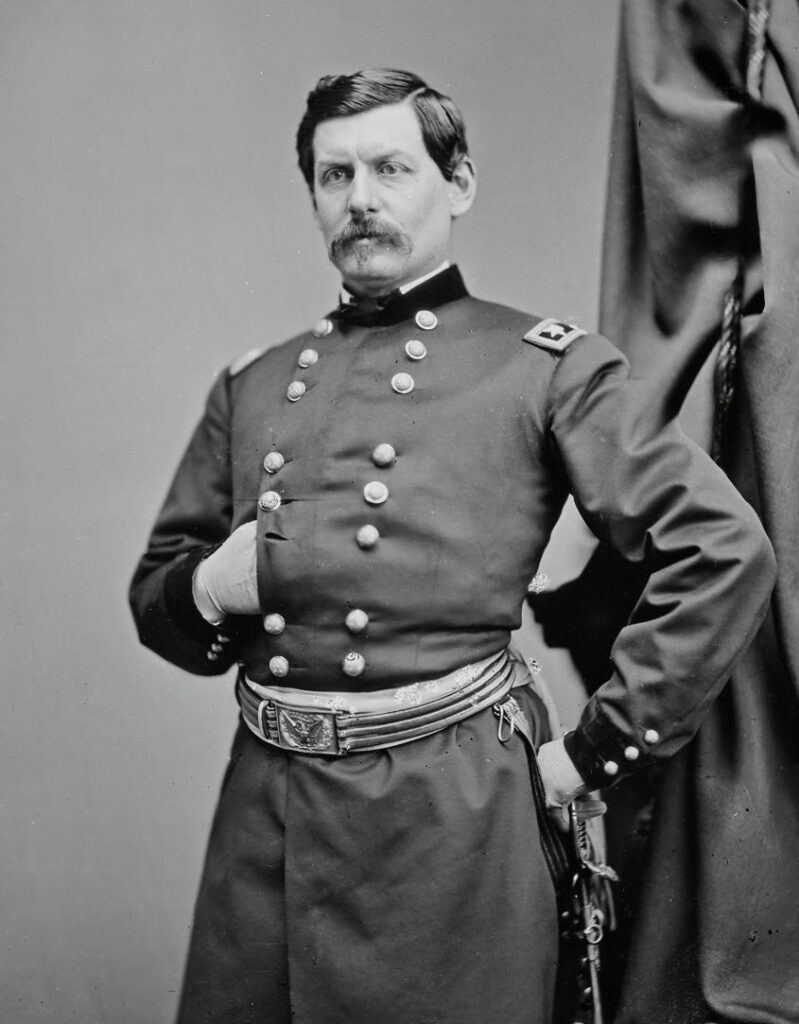
| George B. McClellan, 1826-1885, Pennsylvania Nickname: Little Mac |
| Position at Antietam: Commander of the Army of the Potomac Age at Antietam: 35 |
| Personal: Born in Philadelphia. Son of Dr. George McClellan, founder of Jefferson Medical College; Married Ellen Marcy in 1860; One daughter, Mary “May” born 1861 |
| Education: West Point Class of 1846, ranked 2nd of 59; Classmates: Jesse Reno, Stonewall Jackson, George Pickett, Truman Seymour, Samuel Sturgis, David R. Jones; A.P Hill & Ambrose Burnside one year behind; Commissioned in the Corps of Engineers. |
| Mexican War: Engineer duty (positioning artillery, reconnaissance); Served with Robert E. Lee and P.G.T. Beauregard; Awarded two brevets for gallantry (Churubusco and Chapultepec) |
| Other military career highlights: Participated in engineering surveys; Youngest member of military delegation sent to Europe during the Crimean War (1855-1856); Invented the McClellan saddle |
| Civilian career highlights: Chief Engineer and later Vice President of the Ohio Central Railroad (1857-1860). Abraham Lincoln was one of his lawyers. |
| Civil War: Major General: Ohio Volunteers (April 23, 1861) Battle of Rich Mountain; Major General, United States Army (May 14, 1861): Commander Army of the Potomac Aug 1861-Nov 1862; Commander in Chief United States Army Nov 1861 – March 1862; Peninsula Campaign March – August 1862, Seven Days Battles; Maryland Campaign September 1861 Battles of South Mountain & Antietam; Loudon Valley Campaign October-November 1862; Relieved of command of the Army of the Potomac Nov 7 1862. Democratic candidate for president 1864; Defeated by Abraham Lincoln; Resigned from the U.S. Army November 8, 1864; In Europe until 1868 |
| Postwar: Various engineering positions; Governor of New Jersey 1878-1881 |
| Death: Heart Attack, October 29, 1885; Last words: “I feel easy now. Thank you.” Age 58 |
“The design was to make the main attack upon the enemy’s left-at least to create a diversion in favor of the main attack, with the hope of something more by assailing the enemy’s right-and, as soon as one or both of the flank movements were fully successful, to attack their center with any reserve I might then have on hand.” George B. McClellan writing his report on the Maryland Campaign.
“Nowhere has a charge of slowness been less justly levelled…On September 2, 1862, McClellan assumed command of the disorganized, dispirited and chaotically intermingled fragments of five separate armies. Within one week, he marched into Maryland with a field army which was still sorting out its wagons and batteries and leavened by a high percentage of raw troops snatched directly from the mustering-in ceremonies. In another week he brought Lee to bay at Antietam and inflicted on
him the severest casualty rate ever suffered by the Army of Northern Virginia in the bloodiest days battle of the entire war.”
Joseph Harsh Author Taken at the Flood
“I asked General Lee which of the Federal generals he considered the greatest, and he answered most emphatically “McClellan by all odds” July 15, 1870 visit with Mr. Cassius Lee
“I thought I knew McClellan, but this movement of his puzzles me.” Stonewall Jackson September 15, 1862
“Boys, McClellan is in command again! Three cheers!” John Hatch September 3, 1862
“It has always been my opinion that the true course in conducting military operations, is to make no movement until the preparations are as complete as circumstances permit” McClellan in his memoirs
“He excels in making others fight” Abraham Lincoln
“[the men] fight better under him than under anybody else.” John Gibbon