
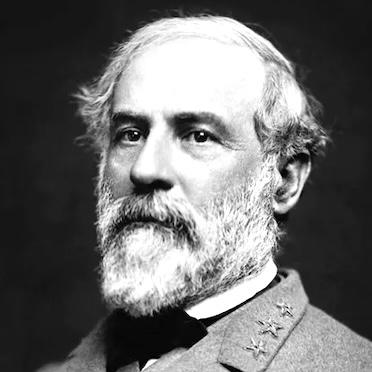
Position at Antietam
Commander, Army of Northern Virginia (Age 55 at the battle)
Personal
1807-1870 Virginia
Nickname: Marse/Uncle Robert
Born in Stratford, Virginia. Son of General “Light Horse” Harry Lee, George Washington’s cavalry commander and governor of Virginia. Married Mary Custis, step-great-granddaughter of George Washington in 1831; Seven children: George “Custis,” Mary, William “Fitzhugh,” Anne, Eleanor, Robert, and Mildred.
Education
West Point Class of 1829, ranked 2nd of 46; Classmates: Joseph Johnston; One year behind Jefferson Davis; Commissioned in the Corps of Engineers.
Mexican War
Engineer duty (positioning artillery, reconnaissance); found routes of attack Mexicans considered impassible; Awarded three brevets for gallantry (Cerro Gordo, Churubusco and Chapultepec).
Other military career highlights
Constructed levee system around St. Louis; Defenses of New York harbor and Fort Pulaski; After Mexican War was Superintendent of West Point, 1852-1855; Lieutenant Colonel, Second U.S. Cavalry, 1855-1861; Harpers Ferry expedition 1859 (captured John Brown); Declined offer of a high-level command in the Union Army, April 1861; Resigned April 25, 1861.
Civilian career highlights
N/A
Civil War
Commander, Virginia Military Forces, April 1861, defeated at Cheat Mountain in western Virginia in Sep; Commander, Dept of South Carolina, Georgia and Florida, responsible for coastal defense; Military Advisor to President Davis, April 1862 – June 1862; Commander, Army of Northern Virginia, June 1862 – April 1865; Appointed Commander in Chief of the Confederate Armies, February 1865; Surrendered April 9, 1865 at Appomattox.
Postwar
President, Washington College in Lexington, Virginia – October 1865 until his death.
Death
Suffered a stroke September 28, 1870; Died October 29, 1870; Last words: “Tell Hill he must come up! Strike the tent,” Age 63.
Quotes
“The very best soldier I ever saw in the field.” Winfield Scott
“The present seems to be the most propitious time since the commencement of the war for the Confederate Army to enter Maryland. The two grand armies of the United States that have been operating in Virginia, though now united, are much weakened and demoralized.” Lee, September 2, 1862
“Lee is audacity personified. His name is audacity.” Joseph Ives, June 16, 1862
“Still,we cannot afford to be idle, and though weaker than our opponents in men and military equipments, must endeavor to harass if we cannot destroy them.” Lee, September 3, 1862
“To be a good soldier, you must love the army. To be a good commander, you must be willing to order the death of the thing you love.” Lee in conversation with James Longstreet
“…found it hard, the enemy in sight, to withhold his blows.” Longstreet writing of the Maryland Campaign in his memoirs
“I do everything in my power to make my plans as perfect as possible, and to bring my troops upon the field of battle; the rest must be done by generals and their troops, trusting to Providence for the victory.” Lee
“Never so uncomfortable as when comfortable.” Walter Taylor
“[Lee] was a general not to be trifled with or carelessly afforded an opportunity of striking a fatal blow.” George B. McClellan
“His talent for topography was peculiar, and he seemed to receive impressions intuitively, which it cost other men much labor to acquire.” Raphael Semmes
“So great is my confidence in General Lee that I am willing to follow him blindfolded.” “Stonewall” Jackson