
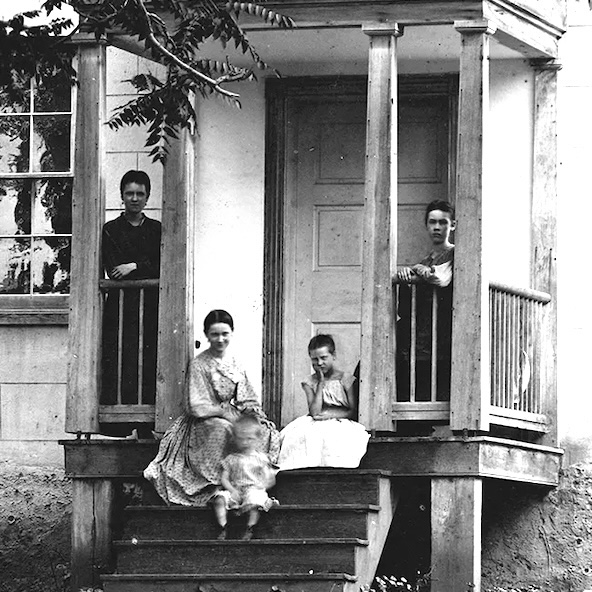
Position at Antietam
Civilian farmers (David – Age 47 and Margaret – 37 at the battle)
Family and Farm
- Son of Colonel John Miller. During the War of 1812, John was a colonel in the militia and continued to be referred to as Colonel Miller. John Miller had owned the farm and David tenanted it on shares. John operated not only a store, but the town post office, a hotel, a gristmill and also owned four farms in the area.
- David R. Miller and Margaret B. Pottenger (m. 1846)
- Five children in 1862, ages 2-13; would have five more.
- Farm – @ 265 acres with 30-acre cornfield
- Farmhands – William Waterman, Seasonal – John H. Gattrell; David’s son – William.
- Wheat, clover, and corn. Near the west side of barn, a number of haystacks stood and the garden was “sprawling with pumpkins, potatoes, and beans.”
- Family went to Pennsylvania for safety before the battle.
- David’s brother, William M. Miller, served in the 2nd Virginia Infantry, Co. B (Stonewall Brigade)
- David had two brothers-in-law who served in the Confederate army — Franklin P. Turner and George W. Van Lear
Historical ownership and Structural Changes
- 1769 James Chapline inherited property tract known as “Loss and Gain”
- 1797 John Myers, farmhouse and barn were first built, additional ell on the north side of the building would include a dining room, kitchen and porch. Two tenant houses, a blacksmith shop, an out-kitchen, a spring and two gardens. The barn, a stable, a corn crib-wagon shed and hog pens across turnpike.
- 1844, Col. John Miller purchased the farm for $53.00 per acre.
- 1853 Hagerstown – Sharpsburg Pike chartered
- 1882 Col Miller dies, property subdivided and put on public sale
- 1883 D.R. Miller purchased the farm he had lived on for almost forty years
- 1886 farm was sold to Euromus Hoffman
- 1933 John C. and Emma F. Poffenberger
- 1950 William and Lucy Barr
- 1952 Paul and Evelyn Culler
- 1989 Conservation Fund and donated to the NPS in 1990
Battle of Antietam
- At daybreak, Gen. Joseph Hooker’s First Corps, approximately 8,000 men, advanced south through the Cornfield.
- The famed “Iron Brigade”, Union soldiers from Wisconsin and Indiana under Brig. Gen. John Gibbon advanced through the Miller farm at the start of the battle, while Brig. Gen. Abram Duryee’s Union brigade advanced through the Miller Cornfield.
- Battery B, 4th U.S. Artillery was positioned just south of the Miller barn and across the Pike to the farmstead.
- At 7:00 a.m., Brig. Gen. John Bell Hood’s Confederate division of approximately 2,000 men waiting behind the Dunker Church, were called into battle by Gen. Jackson. Hood’s men drove north, forcing the First Corps back across the Cornfield.
- Brig. Gen. D. H. Hill’s command at the Sunken Road was ordered to move north into the Cornfield. Some of these regiments attacked all the way to the northern edge of the Cornfield, where they were crushed by the arrival of the Union Twelfth Corps.
- At 8:00 a.m., Maj. Gen. Joseph Mansfield’s Twelfth Corps, over 7,000 soldiers, arrived and drove back Hood’s men and the Confederate reinforcements from the Sunken Road. Maj. Gen. Mansfield was mortally wounded and Brig. Gen. Alpheus Williams took command of the Corps.
- At about 9:00 a.m. there was a short lull in the action. Most of the Confederates on the north end of the battlefield retreated to the West Woods and almost 8,000 Union and Confederate soldiers had been killed or wounded in and around the Cornfield.
Aftermath
- Dr. Biggs made 18 house calls to the Millers in November and December ‘62
- Claim of David R. Miller: Loss of furniture, beds, a horse cart; 60 tons of hay @ $10/ton, $1080 worth of clover seed, and four horses. Filed a claim of $1,237.75 for damages of which he received $995.00 from the Federal Government on July 6, 1872.
- Claim of Col. John Miller: Building damages: $25 house, $40 for blacksmith shop & granary. Petitioned the gov’t for $1,000 on account of “Ground furnished to bury not less than 2000 soldiers.”
- 275 panels post rail plank and paling fence @ $1.25 – $343.75
- 2291 panels worm fence 22910 rails .06 – $1374.60
- 4 large gates & 2 pr bars $15.00
- 15 cords seasoned wood $3 – $45.00
Postwar
- The Millers continued to live on the farm for the next twenty years.
- When David’s father, John Miller, died in 1882 he left a large amount of property to his eight children. However, he left no recorded will that dictated how his estate should be split among them.
- The siblings would fight over D.R. Miller’s property, which he had lived on for almost forty years. A bitter court battle ensued, which lead to the sale of the property; the revenue was then divided amongst all of John’s children.
- In 1883, D.R. and Margaret Miller purchased the farm, but they sold it a little over two years later to someone outside of the family, Euromus Hoffman.
- All the children would leave Sharpsburg (CA, OH, PA, DC) One daughter, Molly, became a missionary and moved to Calcutta, India.
Death
Margaret died November 13, 1888, age 63. D.R. died September 10 1893. Age 78. Both are buried in the Mountain View Cemetery, Sharpsburg, MD
Quotes
Referring to D.R. Miller’s cornfield and the fighting that took place there, Union First Corps Commander, Gen. Hooker would write in his official report that, “every stalk of corn in the northern and greater part of the field was cut as closely as could have been done with a knife, and the slain lay in rows precisely as they stood in their ranks a few moments before. It was never my fortune to witness a more bloody, dismal battle-field”.
Confederate Gen. John Bell Hood wrote of the fighting near the Cornfield: “It was here that I witnessed the most terrible clash of arms, by far, that has occurred during the war.“
Dr. A. A. Biggs wrote, “Almost every step for several hundred yards around, dead rebels could be seen. The sight was awful.” Biggs added, “The bodies of the men were laying around mangled in every conceivable manner. Legs off and heads and parts of heads off, and mortal wounds of every description.”
Frank H. Schell, a sketch artist for Frank Leslie’s Illustrated Newspaper, observed a “feast of horrors” on David R. Miller’s farm. “On the west side of the pike,” Schell wrote, “were Miller’s barn, haystacks, and mowing and threshing machines, in close communion with the open-mouthed cannon and other implements of destruction. The wheat was gathered in, the corn was destroyed, and the crop of corpses and misery was being industriously harvested in all directions.”
Sergeant Charles D. M. Broomhall of the 124th Pennsylvania assigned to burial duty witnessed the slain Confederates near David R. Miller’s farm “ninety three of them, with their heads to the fence, on whom I could have walked without touching the ground, and they were not all the dead that were there.”
David R. Miller claimed that his “cart and gears were taken by the soldiers and were used for hauling some of the dead and wounded soldiers.”
Henry F. Neikirk described D.R. Miller’s farm “was completely stripped by the troops, leaving but little for himself & family to subsist upon.”