
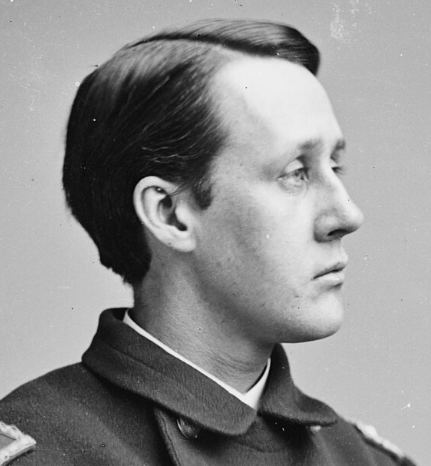
Position at Antietam
Commander, 61st & 64th New York Infantry, Caldwell’s Brigade, Richardson’s Division, Second Corps, Army of the Potomac (Age 28 at the battle)
Personal
1834-1896 New York
Born in Brooklyn, NY, son of a Unitarian minister, but raised in his mother’s hometown of Brookline, Massachusetts. April 1861, married Arabella Wharton Griffith, ten years his senior, and left the next day to enlist in the 12th NY militia. His wife served as an army nurse and nursed him after his wounding at Antietam. She died of typhus on July 27, 1864. Barlow married Ellen Shaw, sister of Robert Gould Shaw, in 1867.
Education
Studied law at Harvard University, graduated first in his class in 1855.
Mexican War
N/A
Other military career highlights
N/A
Civilian career highlights
Was practicing law on the staff of the New York Tribune when Civil War broke out.
Civil War
In April 1861, enlisted as a private in the 12th New York militia regiment, a three-month regiment. He was commissioned a first lieutenant in May. In November, he was lieutenant colonel of the 61st New York and by May of 1862 was its colonel. Fought in the Peninsula Campaign. Barlow’s regiment outflanked and broke through the Sunken Road at Antietam where he was severely wounded. Commanded a brigade at Chancellorsville and a division at Gettysburg where he was seriously wounded again. Commanded a division during the Overland Campaign. One of few men who entered the Civil War as a private and ended as a general.
Postwar
Served as U.S. Marshal, NY Secretary of State, and Attorney General. Active in Republican party.
Death
Died of Bright’s disease in New York City on January 11, 1896, at the age of 62.
Quotes
“War is a savage business and it is idle to try to introduce tenderness into it, except so far as relates to the care of soldiers and the treatment of the sick and wounded. If, after every action, each regiment should condemn to death every man who had fallen out without urgent reasons, or had flinched in battle (and a man’s comrades, after a while, understand these things), it would establish a discipline and a spirit which would have saved thousands of lives. Harsh as this may seem, it would in the end be the greatest humanity, for when cowards and stragglers are pardoned or honored, it is at the expense of brave and faithful soldiers.” Francis Barlow
“(Barlow carried) a huge saber, which he says he likes, because when he hits a straggler, he wants to hurt him.” Theodore Lyman, an aide to General George Meade
“I am more disposed to regard Barlow as a military genius than any man I have yet seen.” Charles F. Adams
“Whatever praise is due to the most distinguished bravery, the utmost coolness and quickness of perception, the greatest promptitude and skill in handling troops under fire, is justly due to him. It is but simple justice to say that he has proved himself fully equal to every emergency, and I have no doubt that he would discharge the duties of a much higher command with honor to himself and benefit to the country.” John Caldwell, Barlow’s brigade commander at Antietam
“Instead of halting his men where Meagher had, he [Barlow] rushed forward half the distance to the rebel line and opened fire. We were so near the enemy, that when they showed their heads to fire, they were liable to be knocked off.” Charles A. Fuller, Regimental Historian of the 61st New York Infantry
“I never saw such a sight as Barlow’s advance, and never expect to again. It was a picture, it was poetry. The whole regiment gazed with admiration on him…He chased the enemy from the ground and drove them almost a mile.” Ezra Ripley, in a letter to a friend after the battle.
“He spoke his thoughts without restraint, and with a singular and almost contemptuous disregard of consequence.” A classmate at Harvard