
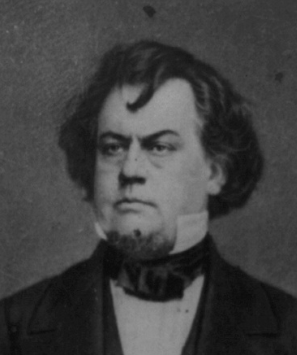
Position at Antietam
Brigade Commander, D.R. Jones’ Division, Army of Northern Virginia (Age 52 at the battle)
Personal
1810-1885 Georgia
Born near Washington, D.C. Son of Robert Toombs, a planter; Married Martha DuBose in 1830; Three daughters.
Education
Franklin College of the University of Georgia (expelled); Graduated Union College, Schenectady, NY in 1828; University of Virginia Law School.
Mexican War
N/A
Other military career highlights
N/A
Civilian career highlights
Large plantation owner. Politician: Georgia Legislature; U.S. House of Representatives, 1844-1853; U.S. Senator 1853-1861; Whig-Unionist until Georgia seceded from the Union.
Civil War
Unsuccessful candidate for president of the Confederacy; Secretary of State until July 1861; Brigadier General; Resigned from the Army in March 1863; Strongly critical of President Davis; served in the Georgia militia later in the war.
Postwar
Fled to Cuba, then Paris after the war; Returned in 1867; Refused to accept a pardon; Resumed practice of law and reentered politics; One term in the U.S. House of Representatives; Became a leading politician in Georgia in the post reconstruction era.
Death
By 1883, he sank into depression, alcoholism, and ultimately suffered blindness. Wife died in September 1885, Toombs died December 15, 1885 in Wilkes County Georgia, age 75.
Quotes
“A bullish politician whose blend of acerbic wit, fiery demeanor, and political tact aroused the full spectrum of emotions from his constituents and colleagues …. [he] could not balance his volatile personality with his otherwise keen political skill.” Historian Jacob Clawson
“Science [West Point] will do anything but fight. It will burn, retreat, curse, swear, get drunk, strip soldiers, anything but fight.” Toombs, who describes West Pointers as “science” in a letter to his friend Confederate Vice President Alexander Stephens
“If Toombs had been educated at West Point, where he could have learned self-control, he would have been as distinguished as a soldier as he was as a civilian.” James Longstreet
“General Toombs was quite conspicuous. Everyone knows that that luminous intellect embraced no soldier’s talent. It might have been so with study, but the Georgian was for once and all a politician, and in the wrong shop with a sword and uniform on.” Moxley Sorrel
“We only hope to get another Gen. who will treat us as kind and be respected by his command as well as Gen. Toombs was respected & regarded by his.” A 15th Georgia soldier describes the reaction when Toombs leaves the Army “…was not entirely a subordinate & respectful brigadier.” E. Porter Alexander
“I have understood that the credit of retaking Sharpsburg was perhaps claimed for General A.P. Hill. Toombs is the man, however.” Henry Benning
“A retreat would have left the town of Sharpsburg and General Longstreet’s rear open to the enemy and was inadmissible. I, therefore, with less than one-fifth of the enemy’s numbers, determined to give him battle.” Robert Toombs
“…is ready for another revolution. He curses freely everything Confederate from a president down to a house boy.” An observer
“Kind, pushy, funny, arrogant, charming, eloquent, sarcastic, dedicated, slovenly, candid, manipulative” and “whatever else, his mood or circumstances required.” Toombs’ biographer Robert Scroggins