
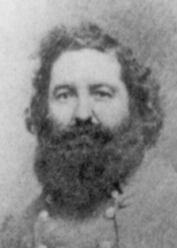
Position at Antietam
Division Commander, Longstreet’s Wing, Army of Northern Virginia (Age 41 at the battle)
Personal
1821-1897 Georgia
Born in Augusta Georgia. In 1849, he married Emily Allison Taylor, niece of President Zachary Taylor. They had seven children.
Education
Graduated from West Point in 1842, ranking 48th out of 56 cadets. Classmates: Longstreet, D.H. Hill, Doubleday and Sykes.
Mexican War
On recruiting duty during the Mexican War and did not see combat.
Other military career highlights
Infantry officer in the 7th U.S. Infantry stationed in the west and in Utah during the Mormon War. Resigned on March 23, 1861 after Georgia seceded from the Union.
Civilian career highlights
N/A
Civil War
June of 1861, assumed command of the 10th Georgia Infantry. Promoted to Brigadier General on September 25, 1861; Major General May 23, 1862. Led his division in the Seven Days battles though only lightly engaged. Not at Second Manassas. In Maryland Campaign, commanded two divisions during Harpers Ferry expedition and his own division at Antietam which launched an attack into the Union division of John Sedgwick in the West Woods, driving Sedgwick back. Remained in division command at Fredericksburg, Chancellorsville, Gettysburg; moved with his division under Longstreet to Tennessee. Relieved of command and court-martialed by Longstreet for an unsuccessful attack at Ft. Loudon in Tennessee. Though exonerated, he never regained command of his division.
Postwar
Following the Confederate surrender, he was an insurance agent, tax collector and postmaster.
Death
July 24, 1897, at his home in Savannah Georgia from a sudden attack of acute indigestion; age 76.
Quotes
“He was an officer of much experience and most careful. Fond of detail, his command was in excellent condition, and his ground and position well examined and reconnoitered; not brilliant in the field or quick in movement there or elsewhere, he could always be counted on and secured the entire confidence of his officers and men.” Moxley Sorrel
“McLaws was rather a peculiar personality. He certainly could not be called an intellectual man, nor was he a brilliant and aggressive soldier; but he was regarded as one of the most dogged defensive fighters in the army. His entire make-up, physical, mental and moral, was solid, even stolid. In figure he was short, stout, square-shouldered, deep-chested, strong limbed; in complexion, dark and swarthy, with coal-black eyes and black, thick, close-curling hair and beard. Of his type, he was a handsome man, but the type was that of the Roman centurion; say that centurion who stood at his post in Herculaneum until the lava ran over him.” Robert Stiles, an artillery officer
“In the final analysis, the men who served under Lafayette McLaws began to shape how history would view their commander. His engraved tombstone in Savannah’s Laurel Grove Cemetery reads, ‘He knew when to lead us in, and he always brought us out.’ His troops knew him for what he was, a soldier’s general.” From A Soldier’s General: Major General Lafayette McLaws by John Oeffinger.
“McLaws was about the best general in the army for that sort of job [positioning troops], being very painstaking in details & a good eye for the ground.” Porter Alexander, Longstreet’s Chief of Artillery
The very best division commander…for the thorough organization and discipline of the division, for the care of his men, and for his untiring personal zeal and energy in the study of the ground around him, and in his foresight and preparation for all contingencies.” Porter Alexander, Longstreet’s Chief of Artillery
“[not] popular with his raw troops, who generally designated him by the sarcastic title of ‘Marse Make-Laws.’” Newspaper article, Southern Historical Collection, University of North Carolina at Chapel Hill