
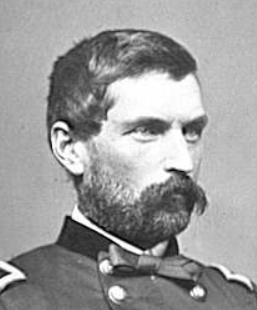
Position at Antietam
Brigade Commander, Doubleday’s Division First Corps, Army of the Potomac (Age 41 at the battle)
Personal
1827-1896 North Carolina
Nickname: “Pompey” (West Point nickname)
Gibbon was born in Philadelphia, PA. His family moved to Charlotte, NC when he was 11 years old when his father took a position as chief assayer at the U.S. Mint. In 1855, Gibbon married Francis “Fannie” North Moale. They had four children.
Education
Graduated from West Point in 1847, ranking 20th out of 38 cadets.
Mexican War
Served in Mexico without seeing combat.
Other military career highlights
An artillery officer in the 4th U.S. Artillery served in Florida and in the West. Taught artillery tactics at West Point where he wrote The Artillerist’s Manual in 1859. Commanded Battery B, 4th U.S. Artillery in Utah at the start of the war. Loyal to the Union, though three brothers served in the Confederate military.
Civilian career highlights
N/A
Civil War
Chief of artillery for Maj. Gen. McDowell. In 1862, appointed brigadier general and commanded a brigade of westerners that eventually became known as the “Iron Brigade.” Gibbon quickly set about drilling his troops and improving their appearance. Led brigade in action at Brawner’s Farm, Second Manassas, and South Mountain. At Antietam, he was forced to take time away from brigade command to personally man an artillery piece in the bloody fighting at the Cornfield. Promoted to division command and later acting corps commander.
Postwar
Remained in the army after the war. Retired in 1891.
Death
Gibbon died in Baltimore on February 6, 1896, aged 68. Buried in Arlington National Cemetery
Quotes
“General Gibbon, in this delicate movement, handled his brigade with as much precision and coolness as if upon parade, and the bravery of his troops could not be excelled.” George B. McClellan
“General Gibbon, mounted upon his horse and riding upon high ground where he could see his whole line, shouted orders in a voice loud and clear as a bell and distinctly heard throughout the brigade. It was always, ‘Forward! Forward!” Rufus Dawes, 6th Wisconsin
“General Gibbon was in the battery, and seeing the advantage which the enemy had, ordered one of the guns which was placed on the turnpike to be used against the enemy’s infantry in the cornfield, General Gibbon acting as both cannoneer and gunner at this piece.” James Stewart, a lieutenant in Battery B, 4th U.S. Artillery at Antietam
“His tendency was strong to get up to the front where the bullets flew carelessly.” Gibbon’s aide Frank Haskell
“Hard at work trying to knock the kinks out of it and indoctrinate the officers and men into the ways of the regulars. It is sometimes pretty hard work, but I am getting along as well as can be expected, and I think I have a very fine brigade.” John Gibbon describing the training and drill of his battery
“I made a discovery which was of infinite value to me thereafter. With these men ‘the hope of reward was far more powerful than the fear of punishment’ and thence forward I acted on that principle.” Gibbon discusses his theory for dealing with volunteer soldiers
“You’ll just feel that you hadn’t better call him Johnnie.” An enlisted man describes the demeanor of his brigade commander, John Gibbon
“We have a splendid Brigadier General. He is regular old fire on strict discipline – no man can leave the ranks on the march – or the camp – without his permission. He attends to his troops very closely, knows all that is going on, in fact he is a model General.” Lucius Fairchild, regimental commander in Gibbon’s brigade
“We have one of the meanest Brigadier Generals that ever lived. There aint a man in the regiment but what hates him. Gibens is his name. He is a regular and if we ever get in a fight, he will be the first to fall. Everybody hates his very name.” Indiana soldie