
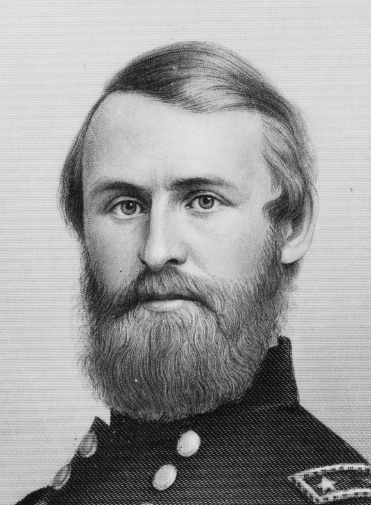
Position at Antietam
Commander, Kanawha Division, Acting Commander, Ninth Corps, Army of the Potomac (Age 34 at the battle)
Personal
1828-1900 Ohio
Born in Montreal, Canada. Son of Jacob Cox, a NY building contractor of Dutch descent. In 1849, married Helen Finny, daughter of the president of Oberlin College, where he was a student. They had eight children
Education
Graduated from Oberlin College, NY, in 1851 with a degree in theology. Oberlin was a progressive educational facility that was coeducational and admitted students of different races.
Mexican War
N/A
Other military career highlights
March 1860, Gov. Dennison of Ohio appointed Cox a brigadier general in the Ohio militia. For the next year, Cox took up the study of military science. On April 3, 1861, appointed brigadier general of Ohio Volunteers
Civilian career highlights
Passed the bar in 1853 and practiced law in Warren, OH; Helped organize Republican party in 1855; Elected to Ohio state senate in 1859. Political allies of James Garfield and Salmon Chase.
Civil War
Commanded an Ohio brigade in the 1861 Kanawha Valley campaign under McClellan. Moved to Washington DC in August 1862, commanded Kanawha division in Ninth Corps. Led division at Fox’s Gap and commanded Ninth Corps at Antietam after Jesse Reno’s death at Fox’s Gap. In 1863 commanded the District of Ohio. In 1864 under Sherman, commanded Third Division of the Twenty-third Corps in Atlanta-Franklin-Nashville and Carolina Campaigns.
Postwar
Governor of Ohio, 1866-1868; Secretary of the Interior, 1869-1870; Railroad president, 1873-1878; Congressman, 1877-1879; Dean of Cincinnati Law School, 1881-1897; Military historian and author.
Death
August 4, 1900 at Gloucester, Massachusetts while on vacation; Buried in Spring Grove Cemetery, Cincinnati. Age 71.
Quotes
“For more than a year before the war I had myself been giving such leisure as I could command to the study of tactics and military history…It was no cursory reading, but downright analytical study, map in hand, determined to find out something of the ‘why’ and ‘how’ of it.” Jacob D. Cox
“I had more confidence in you than any of my Brig. Gens. It is not too late for you to justify my first impression of you.” George B. McClellan
“The straitlaced Cox’s firmness and demand for strict obedience slowly but surely gained the respect of his men though rarely with affection because of his aloof mien, proverbial lack of a common touch, and aversion to tobacco and alcohol.” Eugene Schmiel, author of Citizen General Jacob Dolson Cox and the Civil War Era, 27
“Nothing has touched me more than the universal expression of the unwillingness of my regiments to go into the field without me.” Jacob D. Cox
“I urged Burnside to assume the immediate command of the corps and allow me to lead my own division. He objected that as he had been announced as commander of the right wing of the army, composed of the two corps, he was unwilling to waive his precedence or to assume that Hooker was detached for anything more than a temporary purpose. I pointed out that Reno’s staff had been granted leave of absence to take the body of their chief to Washington, and that my division staff was too small for corps duty; but he met this by saying that he would use his staff for this purpose, and help me in every way he could till the crisis of the campaign should be over. Sympathizing with his very natural feeling, I ceased objecting, and accepted with as good grace as I could the unsatisfactory position of nominal commander of the corps to which I was a comparative stranger, and which, under the circumstances, naturally looked to him as its accustomed and real commander. Burnside’s intentions in respect to myself were thoroughly friendly, as he afterward proved, and I had no ground for complaint on this score; but the position of second in command is always an awkward and anomalous one, and such I felt it.” Jacob Cox