
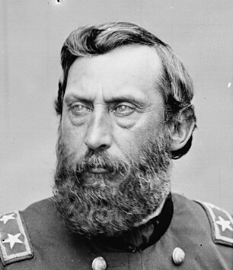
Position at Antietam
Chief of Artillery, Army of the Potomac (Age 43 at the battle)
Personal
1826-1889 Michigan
Born at Detroit Barracks. Son of 1st Lt. Samuel W. Hunt. Orphaned at age 10; raised by uncle John Hunt; Married Caroline DeRussey in 1851 (died in childbirth); married second wife Mary Craig in 1860.
Education
West Point Class of 1839, ranked 19th of 31; Classmates: Henry Halleck, Isaac Stevens, James Ricketts. Commissioned in the 2nd U.S. Artillery
Mexican War
Commanded a section of light artillery. Awarded two brevets for gallantry (first for Churubusco, second for Chapultepec
Other military career highlights
In 1850s commanded Light Company M, 2nd U.S. Artillery. Co-wrote Instructions for Field Artillery (1860) with William French and William Barry.
Civilian career highlights
N/A
Civil War
Part of relief expedition to Fort Pickens in April 1861; May 15, 1861, Major, 5th United States Artillery; Led battery at First Bull Run, July 21, 1861; September 28, 1861, Colonel, Aide-de-Camp, Chief Artillery Reserve, Army of the Potomac; Managed artillery brilliantly at Malvern Hill, July 1, 1862;
September 5, 1862 Chief of Artillery, Army of the Potomac; September 15, 1862, Brigadier General U.S. Volunteers; Commanded the artillery of the Army of the Potomac for the remainder of the war. Brevet to Colonel for Gettysburg.
Postwar
Col, 5th U.S. Artillery, Commanding Officer of Ft. Adams, Rhode Island (May 1869-Nov 1875); President of permanent artillery board; various commands until retirement in 1883; Governor of Soldiers Home in Washington, D.C
Death
1889, buried in the Soldiers’ Home National Cemetery
Quotes
“During the heaviest part of the battle of the ”big guns,” General Hunt, chief of artillery of the Army of the Potomac, rode along the line and gave orders to the commanders of batteries to fire slowly and deliberately; stating that rapid firing did little execution and was a waste of ammunition. He was a small grizzly man with an effeminate voice, but he was an experienced and able artillerist. It is needless to say that the officers and men of the battery heeded his advice and accomplished better results.” Charles Cuffel of Durell’s Battery relates his recollection of Henry Hunt at the Battle of Antietam
“From that time I exercised all the duties of commander of the artillery, as recognized in modern armies, in the same way as at Antietam, where Gen. McClellan told me on the field that he held me responsible for everything in connection with the artillery, and that I might make every use of his name if I came across anybody that ranks me; that is, I took full control of the artillery where by the regulations and necessities of the service, it was not under the exclusive commands of others.” Henry Hunt
“The first measures were directed to procuring supplies of ammunition, and several hundred wagon-loads were, when we were at Rockville, ordered to be forwarded from the arsenal at Washington. Batteries were supplied from the Artillery Reserve to the corps and divisions deficient in guns. Horses were taken from the baggage train and men temporarily detailed from the infantry, and by the time the artillery reached the Antietam it was (considering the condition in which the disastrous campaign in August had left it) very respectably provided.” Henry Hunt
“I regarded him as the best living commander of field artillery. He was a man of the utmost coolness in danger, thoroughly versed in his profession, an admirable organizer, a soldier of a very high order… Hunt’s merits consisted not only in organizing his command to the best advantage but in using it on the field with the utmost skill and power. The services of this most distinguished officer in reorganizing and refitting the batteries prior to and after Antietam, his gallant and skillful conduct on that field and at Malvern, and in fact during the whole Peninsular campaign, merit the highest encomiums in my power to bestow.” George B. McClellan
“In the firing of artillery, accuracy is of far more importance than quickness.” Henry Hunt, September 12, 1862