
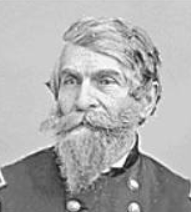
Position at Antietam
Division Commander, Twelfth Corps, Army of the Potomac (Age 61 at the battle)
Personal
1801-1899 Rhode Island
Nickname: “Pap Greene”
Born in Apponaug, Rhode Island, one of nine children of Caleb and Sarah Robinson (Greene) Greene. Hoped to attend Brown University, but his impoverished father could not afford it. Worked at a dry goods store in New York City until admitted to West Point. In 1828, Greene married Mary Elizabeth Vinton, fathered three children; in 1833, Elizabeth and all three of their children died within seven months, probably from tuberculosis. In 1837, married Martha Barrett Dana. They had six children together, including four sons (three of them later served in the military), one daughter, and one son who died in infancy. Eldest son, Lieutenant Samuel Dana Greene, was the executive officer on the ironclad ship USS Monitor
Education
West Point Class of 1823, ranked 2nd of 35.
Mexican War
N/A
Other military career highlights
Assistant Professor of Mathematics and Engineering 1823-1827; served in various garrisons and recruiting duty; Resigned 1836
Civilian career highlights
Civil Engineer on various works in MA, NC, TN, KY and MD, 1836-47; Chief engineer at various railroads, 1847-1856; Engineer in charge of Croton Water Works in Central Park, NY City.
Civil War
Colonel, 60th NY Infantry, Jan 18, 1862; Brig. Gen. (Vols) Apr 28, 1862; commanded a brigade at Cedar Mountain and a division at Antietam; resumed brigade command at Chancellorsville, Gettysburg; Transferred with Twelfth Corps to Western Theater; seriously wounded at Battle of Wauhatchie, Oct 28, 1863. Light duty until January 1865 when he commanded a brigade in the Fourteenth Corps at capture of Raleigh. Brevet Major General (Volunteers) Mar 13, 1865. Mustered out April 30, 1866.
Postwar
Chief engineer for various engineering projects in New York & Washington, D.C.
Death
Died at age 97 in Morristown, New Jersey. Buried in the Greene family cemetery in Warwick, Rhode Island
Quotes
Gruff in manner and stern in appearance; but withal an excellent officer, and under a rough exterior, possessing a kind heart. In the end, the men learned to love and respect him as much as in the beginning, they feared him, this was saying a good deal on the subject. He knew how to drill, how to command, and in the hour of peril how to care for his command… “ Lt. George K. Collins
The accomplishments of Greene and his two small Union brigades (at Antietam) have never truly been recognized. They smashed Colquitt’s brigade; dislodged the stubborn 4th AL, 5th TX, and 21st GA from the East Woods; routed McRae’s brigade; and repulsed two assaults by Kershaw’s and Manning’s brigades, inflicting nearly 700 casualties. Much of their success belongs to Greene’s skillful handling of his men, which enabled them to inflict maximum damage on the enemy while minimizing their own casualties. Scott Hartwig, I Dread the Thought of The Place, 293
“Hooker, Williams, and Greene, in particular, ranged close to their commands, keeping their fingers firmly on the pulse of the battle, and sensing – correctly – where an infusion of groups was most needed…Greene and most of his men performed magnificently.” Scott Hartwig, I Dread the Thought of The Place, 203-4
“The conduct of Greene’s brigade was admirable at this juncture. Although it was exposed for quite a length of time to the fire of the enemy in a position, they could neither shelter nor defend themselves, nor return on the assault; they bore themselves with a calmness and discipline of veterans, emulating the example, so ably given by their brigade commander.” Division commander John Geary reporting on Greene’s conduct at Chancellorsville
“General Geary called a conference of his brigade commanders, and it was understood, submitted to them the question of building, rifle pits; and expressed himself as adverse to the practice on the ground that it unfitted men for fighting without them. General Greene was credited with replying that the saving of life was of far more consequence to him than any theories as to breastworks, and that so far as his men were concerned, they would have them and they had time to build them.” Lt. George K. Collins recalling the decision to build breastworks at Culp’s Hill, Gettysburg.
Conceded to Greene’s brigade the “credit of having successfully prevented the Confederates from turning General Meade’s right flank.” James Longstreet in a postwar speech