
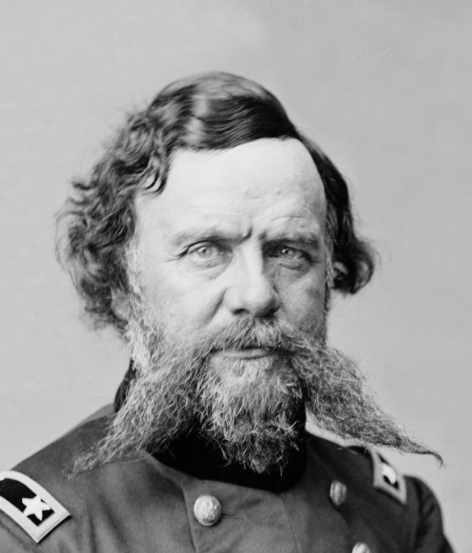
Position at Antietam
Division Commander, Twelfth Corps, Army of the Potomac (Age 51 at the battle)
Personal
1810-1897 Michigan
Nickname: “Old Pap”
Born September 20, 1810 in Deep River, CT. Settled in Detroit, MI, in 1836 after travelling extensively in the U.S. and Europe. Married Jane Larned in 1831. She died in 1849 at age 30. Four children; Charles, Irene, Frederick and Mary. Married Martha Tillman in 1873
Education
Graduated from Yale University in 1831.
Mexican War
Served as lieutenant colonel of the 1st Michigan Volunteers (1847–1848); Served in Mexico but saw no action.
Other military career highlights
Remained active in the Michigan militia, rising to rank of major by the
start of the Civil War.
Civilian career highlights
Admitted to the Michigan bar in the early 1830s; practiced law and served as Wayne County prosecuting attorney and judge of probate. Postmaster and newspaper editor
Civil War
Brigadier General U.S. Volunteers, May 17, 1861; brigade commander in Banks division at Kernstown and First Winchester; division commander at Cross Keys, Cedar Mountain and Antietam. Assumed command of Twelfth Corps on mortal wounding at Antietam; commanded Twelfth Corps at Antietam and
Gettysburg when Gen. Slocum assumed wing command. Transferred west and served as acting commander of Twentieth Corps for extended periods. Repeated assumption of higher command during crises, despite never being promoted beyond brevet major general. Mustered out January 15, 1866.
Postwar
U.S. Minister to San Salvador, 1866-69; U.S. Representative from Michigan, 1875-1878; Author of From the Cannon’s Mouth.
Death
Suffered a stroke on December 21, 1878, and died in the U.S. Capitol Building at 87. Buried in Elmwood Cemetery in Detroit.
Quotes
“He was not a brilliant soldier but a safe one, he never sacrificed his men for the mere sake of winning to himself the attention of newspaper correspondents and the plaudits of the public but whenever hard work was to be done or hard knocks to be received, he was ready. He was social in his habits; kind and considerate to officers and men; ever alive to their needs and comfort and always with them from the beginning to the end. He never received a furlough; his life was in camp with his men.” Ezra Carman
“General Williams handled the corps with judgment and firmness, and I felt entire confidence in leaving it under his charge.” Henry Slocum, who repeatedly left Williams in corps command, wrote approvingly of him after Gettysburg, OR 27, Pt. 1, pp. 758–770
“His predecessor, General A. S. Williams, the senior division commander present, had commanded the corps well from Atlanta to Goldsboro, and it may have seemed unjust to replace him at that precise moment…” William T. Sherman, Memoirs of General William T. Sherman, Vol. II, Chapter on Carolinas Campaign
George Gordon characterized Williams as calm, methodical, and unemotional in command, a general who inspired confidence rather than excitement in his book, Brook Farm to Cedar Mountain (1883).
“I seem destined to command when others are disabled, and to be forgotten when promotions are made.” Alpheus Williams, From the Cannon’s Mouth: The Civil War Letters of General Alpheus S. Williams
“I have no taste for intrigue, and therefore little chance for advancement.” Alpheus Williams, From the Cannon’s Mouth: The Civil War Letters of General Alpheus S. Williams
“I do my work quietly and as well as I can, but I do not make myself conspicuous.” Alpheus Williams, From the Cannon’s Mouth, p. 198
McClellan left little explicit commentary on Alpheus Williams, but his actions speak clearly. When Mansfield was mortally wounded at Antietam, McClellan allowed Williams to assume and retain command of the XII Corps without interference or subsequent criticism—an implicit endorsement from a commander otherwise known for distrust of subordinates