
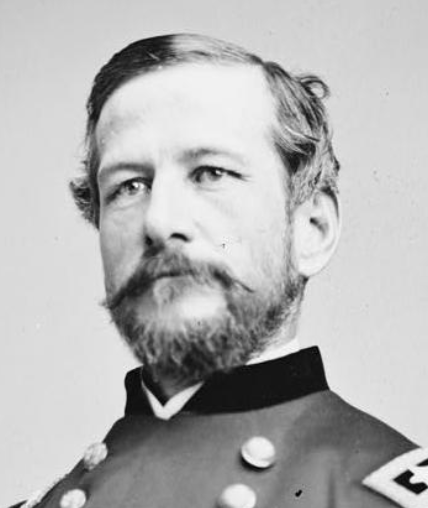
Position at Antietam
Cavalry Division Commander, Army of the Potomac (Age 38 at the battle)
Personal
1824-1897 Washington D.C
Nickname: “Alf”
Born June 7, 1824, in Washington D.C. Married Mary Hone in 1855; four children: Alfred Jr., Henry, Mary, Catherine. Brother Augustus (1806-1894) graduated from West Point in 1826 and served in the Pennsylvania Militia during the Civil War.
Education
Graduated West Point in 1844, ranking 7 out of 41. Classmates: Winfield Scott Hancock, Simon Buckner. Commissioned into 1st Dragoons.
Mexican War
2nd Lieutenant, 2nd Dragoons; brevet 1st Lieutenant for actions at Palo Alto and Resaca De la Palma
Other military career highlights
Served on frontier duty in New Mexico, Texas, Florida, Kansas, Oregon and Utah; marched 2nd Dragoons from Utah to Washington D.C. in October 1861
Civilian career highlights
N/A
Civil War
Major, 2nd Dragoons, February 15, 1862; Brigadier General U.S. Volunteers, July 1, 1862. Served on the Peninsula. Appointed commander of the cavalry division, Army of the Potomac on September 2, 1862. Commanded cavalry at Antietam through the Gettysburg Campaign; Major General U.S. Volunteers June
22, 1863. Reassigned to the Department of Missouri in March, 1864; served there until February, 1866. Regular Army brevets for Antietam, Gettysburg and Missouri.
Postwar
Leave of absence 1866-1868; resigned from the Army on January 1, 1868. Commissioner of Internal Revenue from 1869 until dismissed in 1871. Served briefly as president of the Terre Haute and Cincinnati Railroad, 1871
Death
Lived obscurely in his final years. Died in his sleep on February 17, 1897 and is buried in Congressional Cemetery in Washington D.C.
Quotes
“Colonel Pleasonton has been active and zealous in obtaining information of the enemy, and his services in this respect have been valuable.” George B. McClellan, Maryland Campaign Report
“The cavalry corps has been placed upon a more efficient footing, and its condition is greatly improved.” Joseph Hooker, OR 25, pt. 1
“The command was in excellent condition for service, having been thoroughly refitted and remounted.” William Averell, OR 25, pt. 1
“The cavalry inspections under General Pleasonton were the first I have seen conducted with real rigor and consequence.” George Cadwalader
McClellan regarded Pleasonton as energetic and ambitious, but he was wary of exaggerated reporting and of claims not borne out in action. McClellan correspondence, 1862, in The Civil War Papers of George B. McClellan, ed. Stephen Sears
“The reports … continue to be highly colored, and do not accord with what I learn from other sources.” George Meade correspondence, September, 1862
Hunt complained that “trifling affairs are magnified into important actions,” warning that “the habit of exaggeration in official reports has done much harm.” Henry Hunt, Henry J. Hunt Papers, Library of Congress, Manuscript Division; correspondence, 1863; postwar articles
George Stoneman regarded Pleasonton’s rise as the product of headquarters politics rather than battlefield performance.
“A nice little dandy, with brown hair and beard – a straw hat with a little jockey rim, which he cocks upon one side of his head, with an unsteady eye, that looks slyly at you, then dodges.” Frank Haskell