
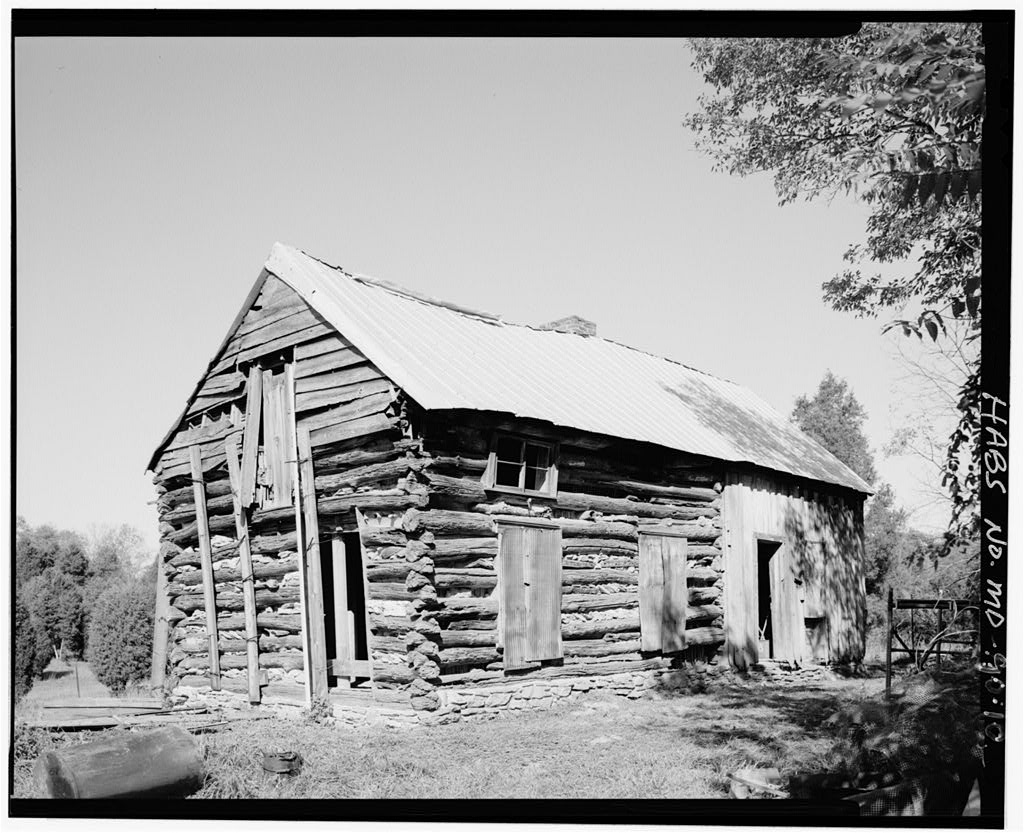
Mary Locher Cabin aka A. Poffenberger Log House
Position at Antietam
Civilian farmers (Alfred age 28 and Harriet 24 at the battle)
Family and Farm
- Alfred and Harriet (Hutzel) Poffenberger (m. 1858). The couple had two children at the time of the battle, ages two and three. A third children was born after the war.
- Joseph Poffenberger was an uncle and Samuel Poffenberger was a cousin.
- 1860 census shows 10y/o Emma Ziah and Peter Kretzer, a 28 y/o farmhand. Kretzer was Alfred’s cousin.
- Property owned by Mary Grove Locher, Lancaster, PA; rented farm for $325 – $400/year. Mary Grove Locher was a widow in 1862. Her husband, Jacob Locher, died before the war.
- Farm – @ 112 acres in wheat, rye, corn and hay. Straw was stacked high in the barnyard
Historical ownership and Structural Changes
- 1734 Richard Sprigg granted land tract know as “Piles Delight”. Log structure built cir. 1760s
- 1791 David McMechen
- 1811 parcel purchased by John McPherson and John Brien house, wash house, wagon shed/corn crib were built.
- 1814 Philip Grove purchases 225 acres
- 1841 Mary Grove inherits half of the property – 112 acres. Most likely rented farm out.
- about 1860 Alfred Poffenberger rents farm. Prior to this house was expanded, large bank barn, root cellar and outbuilding built.
- Some time after 1870 Alfred’s stepbrother, George rents farm
- 1898 George Poffenberger purchases the farm
- 1991 Conservation Fund and conveyed to the NPS
Battle of Antietam
- Union Second Corps advance into West Woods / Sedgewick’s Division hit by McLaws’ Confederates and pushed back through woods.
- House was riddled with bullets
- It is unknown where Alfred Poffenberger and his family went during the battle, but it is certain that they left in a hurry. According to one Confederate soldier who found “the cabin” abandoned just hours before the fighting, he found two loaves of fresh bread which relieved his hunger.
Aftermath
- Over 100 Confederates buried on the property along with 54 Federal soldiers
- Quartermaster agent Victor Vifquain concluded that Confederates took an unknown amount of Poffenberger’s property from September 15-18, and US First Corps forces took the remainder thereafter.
- Alfred Poffenberger testifies there was about fourteen acres of corn taken from the field … [75 bushels] of wheat taken from the stack in the field … forty bushels of rye was taken from the stack in the field … about ten tons of hay was taken from the stack in the field.” Thus, there were several stacks of wheat, rye, and hay in the field at the time of the battle.
- Alfred Poffenberger said that the Confederates destroyed part of his corn, the remainder “was taken from the field by the [U.S.] troops and fed to their horses in lieu of their usual supply of forage from the regular source.”
- Alfred Poffenberger did submit two claims to the Federal Government for Quartermaster stores. He received his “Treasury Settlements” in 1867 and 1869 for claims which included wheat, hay, and com taken between September 20 – 27, 1862 for $144.30, and com, rye, and hay taken September 30, 1862 for $661.40.
Postwar
- Alfred Poffenberger, would assist on his uncle’s (Joseph Poffenberger) farm until 1876, then moved to Iowa.
- Alfred prospered in Iowa, owning at the time of his death 280 acres of land (per his last will and testament).
- Since 1991 the National Park Service has conducted archaeological investigations around the house site and constructed a temporary canopy in order to protect the cabin during the stabilization and restoration process
Death
Harriet died August 18, 1921, age 83. Alfred died October 11, 1894 at age 60. The Poffenbergers and most of their children are buried at Maple Grove Cemetery in Melbourne, Iowa
Quotes
Private Roland E. Bowen of the 15th Mass. Inf. watched a burial crew pile his dead comrades in a mass grave. Upset by the crude interment, Bowen complained, “[T]his is not the way we bury folks at home.”
Alfred Poffenberger, stated in 1887, before F. W. Adams, notary public: “All the satisfaction I could get from the soldiers who took the forage was the assurance that Uncle Sam would settle. I did not know what steps to take to get my pay. These items were taken shortly after the battle of Antietam, about September 20, 1862.”