
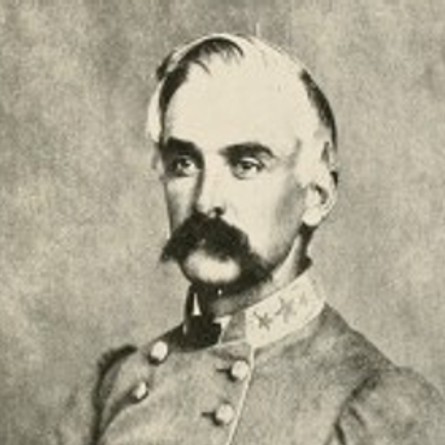
Position at Antietam
Brigade Commander, Munford’s Cavalry Brigade, Army of Northern Virginia (Age 31 at the battle)
Personal
1831-1918 Virginia
Born in Richmond, VA; son of George Wythe Munford (1803–1882), a lawyer and longtime Virginia public official.; In 1853 married Elizabeth Henrietta “Etta” Tayloe; They had at least six children—four sons and two daughters. Etta died in 1864; In 1866, he married Emma Tayloe a cousin of his first wife. They had no children.
Education
VMI Class of 1852 ranked 14th of 28. Classmates included George S. Patton Confederate regimental commander and grandfather of the World War II general; James A. Walker — expelled after challenging Stonewall Jackson, then later commanded the Stonewall Brigade.
Mexican War
N/A
Other military career highlights
N/A
Civilian career highlights
Worked as a cotton planter in Mississippi and later as a farmer in Bedford County, Virginia, before entering Confederate service.
Civil War
Entered Confederate service on May 8, 1861, as lieutenant colonel of the 30th Virginia Mounted Infantry. The unit redesignated the 2nd Virginia Cavalry, and Munford became its colonel in April 1862. Fought at First Manassas and served under Turner Ashby during Stonewall Jackson’s 1862 Valley Campaign. After Ashby’s death, Munford temporarily commanded Jackson’s cavalry and performed well at Harrisonburg and Cross Keys. He subsequently fought in the Peninsula and Second Manassas campaigns, suffering a minor wound during the fighting near White Oak Swamp. During the Maryland Campaign, Munford temporarily commanded Beverly Robertson’s brigade, composed principally of the 2nd, 7th, and 12th Virginia Cavalry. Munford spent much of the war moving between regimental command and temporary brigade command. He never was officially promoted to brigadier general.
Postwar
A farmer, businessman, iron-industry executive, and prolific writer about his wartime experiences. He served as president of VMI’s Board of Visitors from 1884 to 1888.
Death
Uniontown, Alabama, February 27, 1903. Buried in Spring Hill Cemetery in Lynchburg, Virginia.
Quotes
Jackson regarded Munford as a capable officer, but after Port Republic reminded him pointedly that “the only true rule for cavalry is to follow as long as the enemy retreats.”
“He is a gallant officer, and is thoroughly identified with the brigade as its leader. With Munford in command of that brigade, I shall expect hearty cooperation, zealous devotion, and indefatigable attention to his duty.” Stuart recommends that Munford assume command of the cavalry brigade previously commanded by Grumble Jones.
“cavalry commanders do not always post infantry to greatest advantage.” Longstreet criticizing Munford’s deployment of troops at Crampton’s Gap
“the heaviest I ever engaged in, and the cavalry fought here with pistols and rifles.” Munford describing fighting at Crampton’s Gap
“Well Munford, you have had a rough time. You can take your choice either remain here & hold the Gap or go with me to Harper’s Ferry as you please. You or Hampton must go with me.” Stuart to Munford on who should stay and hold Crampton’s Gap.
“I have no hesitation ins saying that the charge made by my own command, in conjunction with…Lieutenant Colonel Munford…caused the jam at Cub Run Bridge which resulted in the capture of fourteen pieces of cannon…and by our charge the enemy were thrown into wild confusion Colonel Richard C.W. Radford reporting on Munford’s role in the fighting at First Manassas.
“We must endeavor to find someone [to replace General Turner Ashby]…How would Col. Thomas T. Munford of Second Virginia Cavalry answer? He seems to be a good officer judging at this distance.” Robert E. Lee in a letter to Secretary of War Randolph considering Munford as a possible replacement for Turner Ashby. June 1862