
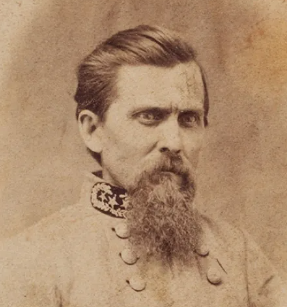
Position at Antietam
Division Commander, Army of Northern Virginia (Age 40 at the battle)
Personal
1821-1893 Missouri
Born July 22, 1821 in Jefferson City Missouri. His father John Walker came from a distinguished political family from Kentucky and Missouri. Two uncles George Walker and David Walker served in the United States Congress. His mother Sarah Caffery Walker was a niece of First Lady Rachel Jackson, the wife of Andrew Jackson. Married in 1859 to Sophia Mary “Mammy” Baylor. whose family was responsible for the naming of Baylor University. Nine children.
Education
In 1844, he graduated from Jesuit College in St. Louis, Missouri.
Mexican War
May 27, 1846 commissioned as a first lieutenant in the US Regiment of Mounted Rifles. Brevet to Captain August 1, 1847 for action at San Juan de los Llanos, and was wounded at Molino del Rey.
Other military career highlights
Promoted to Captain in June 1851. Resigned July 31, 1861.
Civilian career highlights
N/A
Civil War
Major, Cavalry, ACSA Mar 16, 1861; LTC 8th TX Cav August 1861; Colonel September 1861; Brigadier General Jan 9, 1861
Brigade commander September 1861-August 1862; wounded Malvern Hill;
Division Commander, Army of Northern Virginia August 1862 – September 17, 1862; Wounded at Antietam;
Major General November 8, 1862; Transferred to the Trans-Mississippi Department; Given command of 12 Texas regiments, and formed them into a Division known as Walker’s Greyhounds. Walker served exclusively in the Trans-Mississippi Department for the remainder of the war. Wounded at Pleasant Hill Louisiana April 9, 1864. Walker was given command of the Department of Alabama, Mississippi, and Eastern Louisiana in August 1864. By the end of the war, he had been transferred further west, and commanded the District of Texas, New Mexico, and Arizona.
Postwar
At the close of the American Civil War, Walker fled to Mexico, where he remained for several months. In August 1865, Walker travelled to London, England where his wife joined him. There he pursued business ventures. Returning to the United States, he was engaged in mining and railroad operations in the south. In the Cleveland administration he served as the United States Consul in Bogota, Columbia, and as a Special Commissioner to the Pan-American Convention.
Death
Walker died in Washington, D.C. on July 20, 1893, age 73. He is buried in the Stonewall Cemetery, Winchester, Virginia.
Quotes
Whether he did so consciously or not, it seems likely that Walker expanded upon his brief sojourn with the Army of Northern Virginia, and inflated his relatively minor role in the Maryland campaign into a major, speaking part. Within two months of the army’s return to Virginia Walker would be ordered to the trans Mississippi department, the Siberia of the confederacy. Although he’s served with considerable distinction in the southwest for the remainder of the war, he returned to settle in Winchester, Virginia. He may have found comparatively little interest among his neighbors in the heart of Lee’s country in his achievements west of the Mississippi. Joseph L. Harsh, Taken at the Flood: Robert E. Lee and Confederate Strategy in the Maryland Campaign of 1862 (Kent State University Press, 1999), 328.
“Division commander Walker, who also was particularly fond of exaggeration and equipped with a vivid imagination” From Scott Hartwig I Dread the Thought of the Place, 284
“Colonel Walker is, I doubt not, a very competent officer. I knew him as an excellent captain.” General Joseph E, Johnston to Brigadier General Whiting, November 16, 1861, OR 5, 958.
“a timid cautious man and lacks energy, vigor and sagacity” A North Carolina Officer describing John Walker in September 1862 from Stonewall Jackson The Man, The Soldier, The Legend by James I. Robertson. New York: Macmillan Publishing Co, 1997. Page 600.
“The post-and-rail fences stretching across the fields lying between us and the enemy’s position, I regard as the fatal obstacle to our complete success on the left, and success there would, doubtless, have changed the fate of the day. Of the existence of this obstacle none of my division had any previous knowledge, and we learned it at the expense of many valuable lives.” Walker’s Antietam Report OR 19, pt. 1, 1027-1030.