
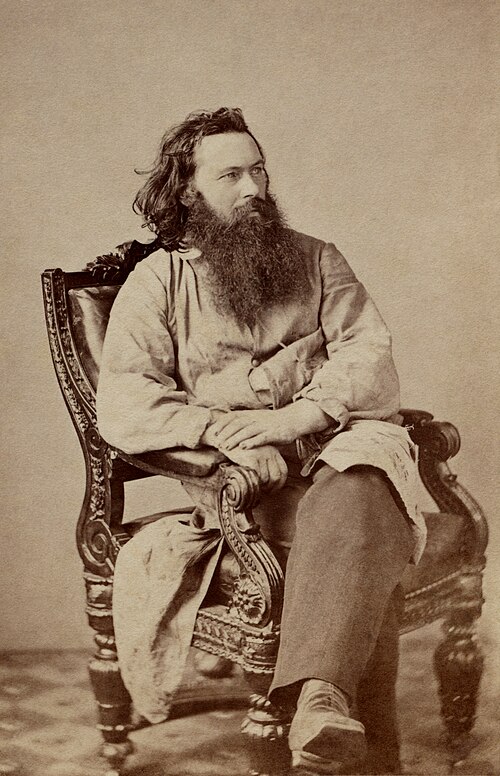
Alexander Gardner
Position at Antietam
Staff photographer for the Army of the Potomac, with the honorary rank of captain. (Age 40 at the battle)
Personal
1821 -1882 Scotland
Born October 17, 1821, in Paisley, Scotland. Married Scotland native Margaret Sinclair, with whom he had a son and daughter.
Education
Left school at age 14 to begin a jewelry apprenticeship which lasted seven years. During that time, he continued his education with evening classes in astronomy, optics, physics and chemistry at the Glasgow Athenaeum.
Civilian career highlights
Gardner developed an interest in photography in 1851 after seeing Mathew Brady’s exhibit at Hyde Park in London. He gained expertise in the wet-plate process and became owner and editor of the Glasgow Sentinel. In the early 1850’s, he and his brother purchased property in Iowa for a collective community and encouraged their friends and family to settle there. Gardner immigrated to the United States in 1856 to join the community, but a tuberculosis epidemic there forced him to stay in New York, where he became an assistant to Mathew Brady. By 1858, Gardner was running Brady’s gallery in Washington, D.C. Upon the outbreak of war, Gardner became one of the top portrait photographers of soldiers.
Civil War
Gardner was one of 20 photographers employed by Brady and equipped with traveling dark rooms to document the Civil War. While on that assignment, he served briefly as chief photographer in the U.S. Topographical Engineers and then became the staff photographer for the Army of the Potomac, with the honorary rank of captain, where he was in position to be the first to capture dead soldiers on a battlefield at Antietam. He remained with the Army of the Potomac for several more months, taking photographs at Fredericksburg before ending his employment with Brady in 1863 over lack of attribution for his photographs. He opened his own studio in D.C. and organized photographers to photograph Gettysburg. He continued his portrait business, including several of President Lincoln, and photographed Petersburg and the execution of the Lincoln conspirators.
Postwar
After the war, Gardner was commissioned to photograph Native Americans who came to Washington to discuss treaties; and he surveyed the proposed route of the Kansas Pacific railroad to the Pacific Ocean. Many of his photos were stereoscopic. After 1871, Gardner gave up photography and helped to found an insurance company.
Death
Died of illness in Washington, D.C. on December 10, 1882, and is buried in Glenwood Cemetery.
Quotes
“Brady was able to bring home to us the terrible reality and earnestness of war. If he has not brought bodies and laid them in our door-yards and along streets, he has done something very like it…” – New York Times review of the exhibit of Gardner’s Antietam photographs. Gardner’s name was not mentioned in the exhibit.
“[My work] is designed to speak for itself, as mementos of the fearful struggle through which the country has just passed, it is confidently hoped that it will possess an enduring interest”. – Alexander Gardner
Such a picture [A Harvest of Death, Gettysburg battlefield, July, 1863] conveys a useful moral: It shows the blank horror and reality of war, in opposition to the pageantry. Here are the dreadful details! Let them aid in preventing such another calamity falling upon the nation. – Alexander Gardner (1866)