
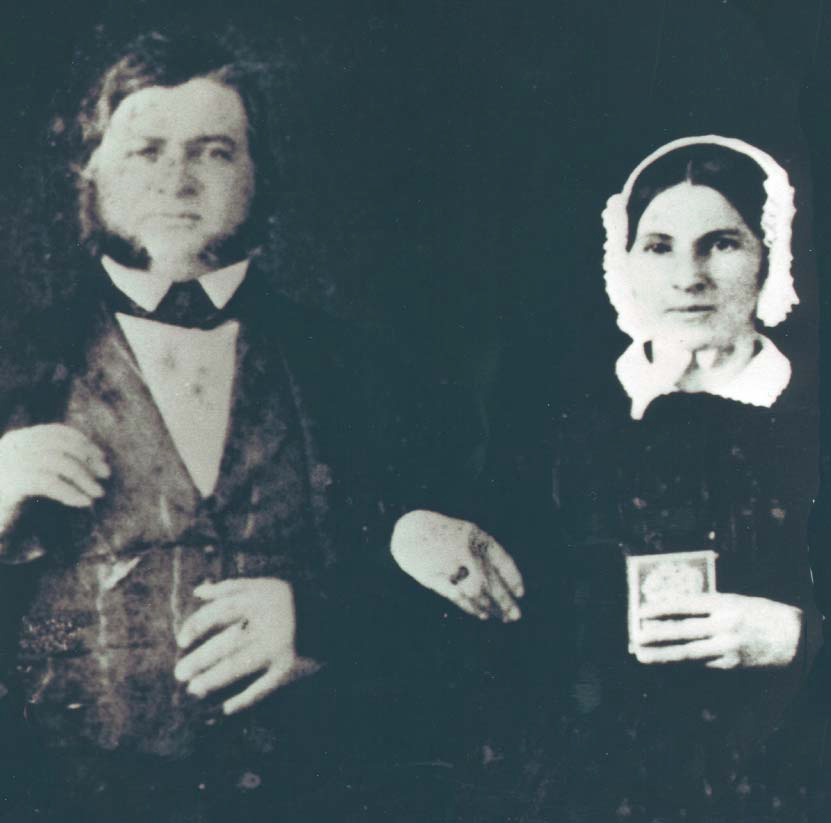
Samuel and Elizabeth Mumma
Position at Antietam
Civilian farmers (Samuel – Age 60 and Elizabeth – 46 at the battle)
Family and Farm
- Samuel and Elizabeth (Miller) Mumma (m. 1833)
- Three children from previous marriage, 11 children together, nine living at home in 1862 ages 24 – 3 years old.
- Farm – @ 186 acres 120 were improved, 50-60 acres of wheat, 25-30 acres clover, 16 acres of corn, small apple orchard. Valued at $11,000.
- 1860 Reported yields – 800 bushels of wheat, 500 bushels of Indian corn, 80 bushels of rye, 75 bushels of Irish potatoes, 5 bushels of clover seed, 20 tons of hay.
- Livestock – 8 horses, 5 milk cows, 17 other cattle, 11 sheep and 20 swine – valued at $900.
- 500 lbs of butter, 60 lbs of wool, $200 worth of meat and $30 worth of apples.
- The Mumma family will go to the Manor Church, four miles north for safety.
Historical ownership and Structural Changes
- Prior to 1761 Farmstead was comprised of at least three separate land grants to various settlers. The largest land grant was known as Anderson’s Delight.
- 1761 John Reynolds,
- 1784 Francis Reynolds inherits property, sold the following year to Christopher Orndorff
- 1785 – 1805 Orndorff family – built the original home, barn, and outbuildings
- 1805 Jacob Mumma purchased property for his son John, two-story brick addition of home constructed
- 1831 property conveyed to Samuel Mumma Jr.
- 1851 transfers 4.5-acre tract to the German Baptist Brethren for the Dunker Church
- 1862 – 1863 house, barn and majority of the outbuildings destroyed and rebuilt
- 1876 Henry C. Mumma purchases farm
- 1885 Rezin D. Fisher, parcels sold for commemorative monuments/first-floor addition built in 1919
- 1923 Walter H. Snyder
- 1924 Hugh G. Spielman
- 1961 The National Park Service (NPS) purchased the property. As part of the “Mission 66” program a new visitor center is built in 1962.
Battle of Antietam
- Samuel Jr. and friend return on September 16th; house ransacked, stopped by Rebel pickets.
- About 7:00am on the 17th, CSA BG Roswell Ripley ordered men to burn the house to avoid it becoming a sniper’s nest. Sergeant Major James F. Clark of the 3rd North Carolina was in charge of the detail that set the house on fire.
- A stray Union artillery shell strikes barn and catches it on fire.
Aftermath
- The Mummas spend the winter at the Sherricks while they rebuild. In June 1863 they move back into the house.
- U.S. forces burned nearly 1,300 panels of Mumma’s fence as well as 15 cords of cut firewood.
- Samuel Mumma drags 55 dead horses from near his burned house and barn into the East Woods.
- On November 10, Mary Jane (Rohrbach) Mumma, daughter in law (Henry C. Mumma) died.
- Mumma lost dozens of items, including an eight-day clock, sleigh blankets, a buffalo robe, parlor stoves, and three-ply carpeting. The blaze also consumed the barn, destroying grains, plows, wagons, and a McCormick reaper. He estimated his structural damages at $3,400 and petitioned the U.S. government for a total charge of $9,255.28.
- Losses included: 592 bushels of corn, 75 bushels of wheat in the stack, 75 bushels of apples, clover pasture, three horses, 12-15 large hogs, along with cattle and sheep. Mumma described the destroyed fence panels as “nearly all the fencing I had on my farm.”
- Mumma, Jr. “called upon the officer who took the stores and asked him for proper papers or vouchers.” The quartermaster, however, “[R]efused to give it and said the government would pay it.”
- Law firm lost Samuel Mumma Sr.’s citizens’ appraisement. Mumma relied on a board of survey appraisement to prove his losses. The quartermaster found this evidence insufficient. “[T]he report of the Board, shows that the claimant suffered severe losses in the destruction by fire of his house, barn, furniture, fencing, hay, &c.” Mumma’s claim was “respectfully returned without recommendation for settlement.”
Postwar
- Court of Claims determined the United States Army took grains, livestock, and fencing valued at $853. paid to Mumma’s estate in 1899.
- Three sons move west after the war; daughter Cora moved to Ohio
- Sergeant Major James F. Clark of the 3NC writes a letter to the Postmaster of Sharpsburg in 1906; Samuel Mumma, Jr.
- The Park Service would allow the last owners, Hugh and Hattie Spielman, to live there until 1985. In the mid-2000s, the Mumma house and farm became the park’s Education Center.
Death
Samuel died on December 7, 1876 at the age of 76, and Elizabeth passed away on August 25, 1886, age 70. Both are buried in the Mumma Cemetery on their farm.
Quotes
Samuel Jr. described his family’s experience as they fled to safety, “My father was told the family had better get away, so we left on Monday afternoon the 15th, took nothing with us as they were cannonading then, and we were afraid there would be a great battle at once. Some clothing was gotten together and the silverware packed in a basket, ready to take but in our haste to get away, all was left behind. Father and mother and the younger children left in the two-horse carry … all going about four miles, and camped in a large church called the Manor Church.”
Sgt. James F. Clark, 3rd NC lead the detail in charge of setting the house on fire. Clark, “recalled throwing a torch through an open window and onto a quilt covered bed. Within a few moments the whole house was in flames.”
Samuel Mumma, Jr., described the condition of his father after the battle, “He was living below Sharpsburg after the battle . . . he was an old man and very much discouraged by the loss of his house and barn.”
Samuel Mumma, Jr.’s explained the high price of folder in their claim,“[W]e got as much as $10 a load for it hauled to Sharpsburg the following year. That year fodder was very scarce after the armies were here and commanded a high price.”
Samuel Mumma, Jr., describing his parents’ losses, “[T]here was 25 or 30 acres of pasture on the place which was pastured by the government
horses.” Part of the meadow was a second year crop and had not yet been cut. Samuel recalled, unfortunately, army horses “were turned in on the fields and kept there until it was gone.”
Samuel Mumma, Sr., lost 80 bushels of wheat inside his barn when it caught fire during the battle. His remaining crop survived the flames, being stacked in the field. Regrettably, it didn’t last long. “All this forage,” Mumma testified, “was taken immediately after the battle of Antietam” on account that the army’s “supply trains were irregular and often interrupted and delayed, and . . . the necessities of the army were great and pressing.”
Samuel Mumma, Jr. recalled, “I talked with both general Meade and Sumner and they said they were out of supplies and that they must have what they could get from my father and that the Government would pay for it.”
The Court of Claims found that most of the Samuel Mumma’s property was “taken or destroyed during the battle as due to the ravages of war and the depredations of individuals.”
The Hagerstown Herald reported on September 24, 1862, that “…Among the heaviest sufferers of Washington County is Samuel Mumma, Esq., whose house and barn were burned, together with all their contents. They were between the fire of the two armies. We learned that Mr. Mumma lost all his household furniture, including the wardrobe of his family, all his grain, hay and farming implements…”