
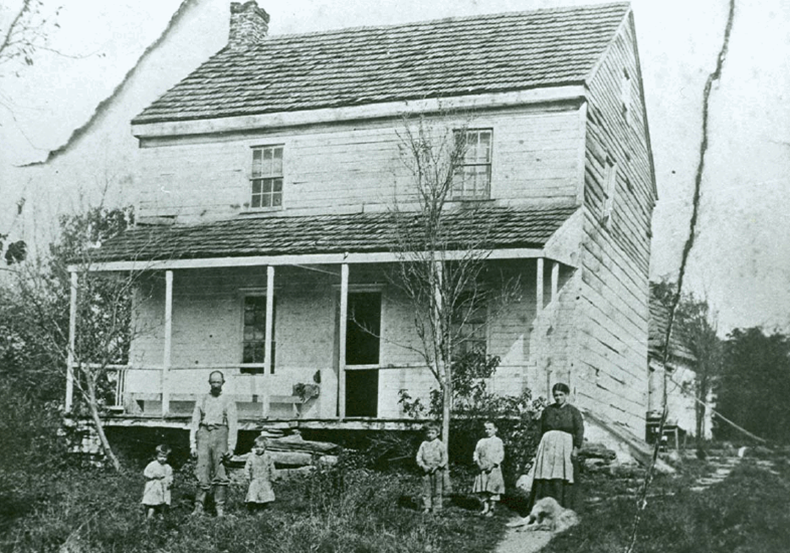
Otho Poffenberger family in front of Joseph Poffenberger’s house, c. 1880
Position at Antietam
Civilian farmers (Joseph – Age 50 and Mary Ann – 44 at the battle)
Family and Farm
- Joseph and Mary Ann (Coffman) Poffenberger (m. 1838)
- No children, relatives like nephew Josiah Poffenberger and a farmhand Isaac Malott may have been working at the farm.
- Tenant, Samuel Kretzer and his wife Ann, had two sons, Raleigh Kretzer, age 2, and Aaron five months in 1862.
- Farm – @ 166 acres: 50 acres in wheat (cut and in the barn / field may have been stubble), 28 acres of corn (two corn fields in 1862; one may have been 21 acres), 21 acres of second growth clover, 10 acres of oats (cut and threshed), 10 acres ground plowed, not seeded, 4 acres rye (cut and threshed), 1 acre potatoes.
- Like most farms, straw was stacked high in the barnyard
- Mary Ann’s cellar with “apple, peach, and plum butter, barrels of pickles and preserves of all kinds. Hundreds of pounds of smoked meat hung in the storehouse, and there was even a barrel of whiskey.”
Historical ownership and Structural Changes
- 1769 James Chapline inherited property tract known as “Loss and Gain”
- 1813 Christian Middlekauff – house, wash house, wagon shed/corn crib
- 1828 Finifrock/Neikirk – bank barn, equipment shed, icehouse, and smokehouse
- 1843 Jacob Coffman assumed ownership of property
- 1852 Joseph Poffenberger purchases farm
- 1880 Otho Poffenberger purchases the farm, building on rear addition to house
- 1932 Joseph W. Poffenberger
- 1944 Elmer L. Poffenberger
- 1966 Fred & Renee Kramer
- 2000 NPS purchased the property
Battle of Antietam
- Union First Corps arrived on the Poffenberger farm on the afternoon of Sept. 16 to prepare to advance toward Dunker Church on the morning of the 17th.
- Gen. Hooker uses the barn as HQ on the 16th as Union troops camp around the farmstead, in the fields, and in the North Woods.
- Union artillery on hill north of barn. Received opening shot from Confederate guns on Nicodemus Heights. “The opposite hill seemed suddenly to become an active volcano, belching forth flame, smoke, and scoriae,” recalled Captain J. Albert Monroe of Battery D, 1st Rhode Island Light Artillery.
- Area becomes a field hospital. Clara Barton arrives @ 1200, most likely moves to other farms that have been set up as hospitals – Middlekauff & Samuel Poffenberger
Aftermath
- Damage done to tenant house ($15), barn & ice house ($14), dwelling house ($5)
- 50 gallons of rye whisky, 20 tons of hay, 500 bushels wheat ($675) and corn ($420), Potatoes, cured meat, garden vegetables. 30 gallons of fruit butter made from peaches, plums and apples
- House stripped of clothing, bedding, kitchenware, carpeting, and fabrics. Other losses included one safe destroyed, a $20 silver lever watch, $10 gold bracelet with diamond, and two strings of sleigh bells.
- 7 cattle, 13 sheep, 20 swine, 204 chickens
- Isaac Malott: “The sheep, hogs and cattle were all taken by the troops in a body … I was with Mr. Poffenberger at the time they were taken. He was so distressed that he could not eat.”
- Union army encamped on the farm until October 20, 1862. Barn used for quartermaster site.
- Claim of $2,277.55 was “disallowed” by the government “because the proof of the stores and supplies was insufficient” and they were “not convinced that the stores and supplies were actually taken and used by the United States Army.”
- Joseph Poffenberger was pro-Union and remained loyal throughout the war. In his claim, Joseph said he was “bitterly opposed to secession.”
Postwar
- Lawson W. Poffenberger, the executor of Joseph’s estate was awarded $1918.00 for a resubmitted claim of $2,721.50 in 1899.
- Alfred Poffenberger, nephew, assisted with the farm for 15 years.
- By 1880, Alfred had moved to Iowa and Joseph turned over the operation of the farm to his nephew Otho J. Poffenberger and his wife Elizabeth. Joseph moved into the tenant house to allow Otho and Elizabeth room in the main house to raise their children.
- In 1895, the War Department purchased property from Otho in order to build a tour road known as Mansfield Avenue, which allowed for the placement of monuments, tablets and markers.
Death
Mary Ann died August 13, 1864, age 47. It is possible that her death was caused by an increase in disease due to the unsanitary conditions and mass burials around Sharpsburg. Joseph died on June 13, 1888. Age 75. Both are buried in the Mountain View Cemetery, Sharpsburg, MD.
Quotes
Gen. Joseph Hooker walked into the barn after inspecting the line and stated to his staff, “We are through for the night, but tomorrow we fight the battle that will decide the fate of the Republic.”
Joseph wrote: “I returned to my house; it was completely empty. I had nothing left. I lived on army crackers that I found on the battlefield for five days.”
Joseph witnessed the loss of his entire wheat crop to elements of I Corps. Poffenberger recalled. “I saw the soldiers take it away … I went to a general of the army and asked him to save my wheat; he told me they needed it for the horses.”
In the testimony of Jacob Eakle: “Claimant’s farm was a perfect wreck after the battle, crops destroyed, house riddled, and everything taken out.”
In Joseph Poffenberger’s claims case, farmhand Isaac Malott stated, “I saw his bacon taken. They took all he had on the place. The troops used it there the day after the battle.”
When the Federals seized the grains at the Poffenberger farm, Isaac Malott recalled “[T]he oats and rye were fed about the barn the day of and the day after the battle,… I saw them take his oats from the barn along with the wheat and rye.”
In 1891, George Line, was testifying that it wasn’t fair that the government had not yet paid Joseph Poffenberger’s estate, stating, “The claimant was cleaned out of about everything on his farm, as well as in his house, and he was probably one of the heaviest losers around,”
War correspondent, Charles Coffin saw “two horses killed by the cannon shot which smashed the head of one and tore open the neck of the other” on the Poffenberger farm.