
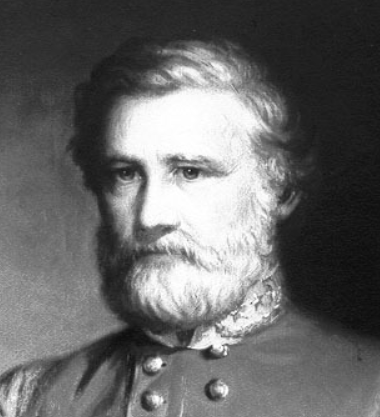
Position at Antietam
Brigade Commander, D.R. Jones’ Division, Army of Northern Virginia (Age 48 at the battle)
Personal
1814-1875 Georgia
Nickname: “Old Rock”
Born on a plantation in Columbia, Georgia. Son of Pleasant Moon and Malinda Meriwether White Benning, he was the third of eleven children. Admitted to the bar 1835. 1839, married Mary Howard Jones (d. 1867), daughter of prominent attorney Hon. Seaborn Jones, who had served as Georgia’s Secretary of State and a U.S. Congressman. The Bennings had ten children; four died of childhood diseases. Henry and Mary may have been the inspiration of Margaret Mitchell’s Gone With the Wind
Education
Franklin College (now University of Georgia). Graduated 1834.
Mexican War
N/A
Other military career highlights
N/A
Civilian career highlights
Elected associate justice of Georgia Supreme Court in 1853; Ardent secessionist; noted for an opinion that held that a state supreme court is not bound by the decisions of the U.S. Supreme Court on constitutional questions but that the two courts must be held to be “coordinate and co-equal.”
Civil War
Considered for a cabinet position in the Confederate government. Colonel, 17th Georgia; Brigadier General April 23, 1863. Commanded a brigade for most of the war. Surrendered at Appomattox; Paroled April 9, 1865
Postwar
Returned to Columbus to resume the practice of law. He found that his house had been burned; all of his savings had disappeared; and he had to support, along with his own family, the widow and children of his wife’s brother, who had been killed in the war
Death
In 1875, Benning had a stroke, termed apoplexy at the time, on his way to court and died in Columbus, age 75
Quotes
“What was the reason that induced Georgia to take the step of secession? This reason may be summed up in one single proposition. It was a conviction, a deep conviction on the part of Georgia, that a separation from the North was the only thing that could prevent the abolition of her slavery” Benning speaking at Virginia Convention, February 18, 1861
“During that long and terrible fire, not a man, except a wounded one, fell out and went to the rear – not a man.” Henry Benning’s report on Antietam
“Old Rock, as the boys loved to call (him), had a good many oddities. Among them, he was very plain of speech, and would talk back in kind with compound interest to any of his men.” Sgt Houghton describes Colonel “Rock” Benning
“During a surprise Union counterattack against his brigade at Chickamauga, many of his men fled, and Benning ran off to Longstreet to report the calamity. Riding an old artillery horse and whipping it with a piece of rope, Benning was “greatly excited and the very picture of despair,” as was reported by Longstreet after the war. Benning said, “General, I am ruined; my brigade was suddenly attacked and every man killed; not one is to be found. Please give me orders where I can do some fighting.” Longstreet responded impassively, “Nonsense, General, you are not so badly hurt. Look about you. I know you will find at least one man, and with him on his feet report your brigade to me, and you two shall have a place in the fighting line.”
Longstreet’s reply humiliated Benning but instilled enough determination in him to return to find his brigade and prevail in the battle.” This interchange is reported in Freeman, Vol. 2, p. 219, n. 53. The original source is Sorrel, p. 20