
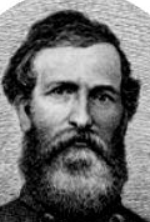
Position at Antietam
Division Commander, Army of Northern Virginia (Age 37 at the battle)
Personal
1825-1863 South Carolina
Nickname: Neighbor
Born April 5, 1825 in Orangeburg, SC; married Sarah Taylor, niece of 12th U.S. President Zachary Taylor. Two children; Evelyn and May.
Education
Graduated West Point in 1846, ranking 42nd out of 59. Classmates: “Stonewall” Jackson and George B. McClellan.
Mexican War
2nd Lieutenant in the 2nd Infantry, participated in the siege of Vera Cruz, the Battles of Cerro Gordo, Contreras, Churubusco, Molino del Rey, and the capture of Mexico City.
Other military career highlights
Instructor of infantry tactics at West Point, acting assistant Adjutant General on the Pacific coast and Department of the West until his resignation in February 1861.
Civilian career highlights
N/A
Civil War
Served on Beauregard’s staff at Fort Sumter; commanded a brigade at First Bull Run. Sent to the Richmond area afterwards to serve under Magruder’s command; Promoted to major general March 10, 1862. In the Seven Days Battles, he temporarily led Magruder’s division when Magruder served as a wing commander. When Magruder departed for the Western Theater in July, Jones got permanent command, leading his troops at Second Battle of Bull Run and the Battle of Antietam under Maj. Gen. James Longstreet. Jones became the highest ranking division commander in the Army of Northern Virginia after Maj. Gen Richard Ewell was wounded at Groveton (part of Second Manassas) on August 28
Postwar
N/A
Death
Jones suffered a heart attack in mid-October 1862 and left the army. He died in Richmond on January 15, 1863, from a long-standing heart condition greatly aggravated by war stresses and the death of his brother-in-law, Henry Kingsbury, who was killed at the Burnside Bridge by Jones’ troops
Quotes
“When it is known that on that morning my entire command of six brigades comprised only 2,430 men, the enormous disparity of force with which I contended can be seen.” D.R. Jones in his report.
“General Jones seized the opportunity and threw Toombs down against the enemy’s flank, drove him back, and recovered our lost ground.” Longstreet in his report describing Jones initiative.
“Although Jones’s line was thin, his location was probably the strongest natural terrain position held by any of Lee’s men, except, perhaps, for the Rohrbach Bridge, and was well suited for artillery. Jones also used the cornfields and undulating landscape to keep his infantry either concealed or under cover, making it difficult for the Federals to accurately gauge the strength of his infantry.” Scott Hartwig, I Dread the Thought of The Place, 528
“Brigadier General D. R. Jones, commanding on our right, gave me such information as my ignorance of the ground made necessary.” A.P. Hill’s Antietam report
“A.P. Hill did not divine the enemy’s vulnerability by himself however. Hill gives credit to the quietly competent David R. Jones. Having been in the vicinity since late afternoon on September 15, Jones was well acquainted with the terrain his division occupied and was able to suggest the best approaches for Hill’s brigades to follow, in order to avoid the Federals’ artillery and close with their infantry.” Scott Hartwig, I Dread the Thought of The Place, 594
“In the afternoon the enemy advanced on our right, where General Jones’ division was posted, who handsomely maintained his position.” Robert E. Lee in his official report, OR 19, pt. 1, 141
“A very agreeable, honorable man, tall and stately, he made a brave appearance and well merited the sobriquet of Neighbor Jones.” Moxley Sorell, speaking of Jones on Jones’ assumption of one of Longstreet’s brigades.