
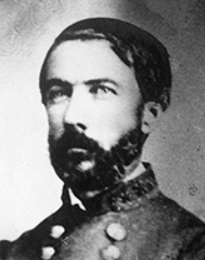
Position at Antietam
D.H. Hill’s Division, Army of Northern Virginia (Age 41 at the battle)
Personal
1821-1889 South Carolina
Nickname: “Old Rawhide”
Born in Iron Works, SC. Son of Solomon Hill, a farmer, who died when Daniel was four. Married Isabella Morrison in 1848; nine children. Isabella Morrison’s younger sister Mary Anna married “Stonewall” Jackson in 1857, making the two men brothers-in-law.
Education
West Point Class of 1842; ranked 28th of 56. Classmates: Lafayette McLaws, James Longstreet.
Mexican War
First Lieutenant in Fourth Artillery; two brevets for gallantry at Molino del Rey and Chapultepec; wounded at Belen Gate where all the other officers in his company were killed.
Other military career highlights
Resigned from the Army in 1849.
Civilian career highlights
Mathematics professor at Washington College in Virginia and later at Davidson College in North Carolina. President of the North Carolina Military Academy
Civil War
Colonel, 1st North Carolina Infantry; Won battle of Big Bethel; Division commander in the Peninsula at Yorktown, Williamsburg and the Seven Days. His division remained around Richmond during the Second Manassas Campaign; Joined Lee’s Army for the Maryland Campaign. Defended Turners and Fox Gap at Battle of South Mountain and the Sunken Road at Antietam; Unengaged at Fredericksburg; Led Confederate reserve troops around Richmond during the Gettysburg Campaign; Transferred to Bragg’s Army of the Tennessee; Fought at Chickamauga; Differences with Bragg led Hill to being reassigned to less important commands. Fought at Bentonville, NC, in the last days of the war. Surrendered with Joe Johnston’s army.
Postwar
Magazine editor of The Land We Love, 1866-1869. President of the University of Arkansas, 1877-1884; President of the Agricultural College of Milledgeville, GA, 1884-1889.
Death
Died in Charlotte, North Carolina, September 24, 1889 at age 68.
Quotes
“The hardest fighter at Sharpsburg…There was never a more plucky or persistent fighter, but he could not resist the temptation when it came to criticize.” James Longstreet
“He would take his men into battle, fight furiously for some time and then something weakened about him. Unless there was some strong character nearby like Longstreet, for instance, on whom he leaned, his attack would be apt to fail, and his first efforts go unrewarded. His speech was bitter, although a most devout Presbyterian elder.” Moxley Sorrel
“I fear General Hill is not equal to his present position. An excellent executive officer, he does not seem to have much administrative ability. Left to himself, he seems embarrassed and backward to act.” Letter to President Davis by Robert E. Lee on Aug 17, 1862
“Harsh, abrupt, often insulting in the effort to be sarcastic, he will offend many and conciliate none. Nor has he talents to reduce this disadvantage, though brave and loyal.” Robert Kean, a Confederate clerk
“…was a capable, well-read soldier, and positively about the bravest man ever seen. He seemed not to know peril and was utterly indifferent to bullets and shell.” Moxley Sorrel
“My impression of Genl Lee is not so enthusiastic as that of most men who served under him.” D.H. Hill
“Hill’s snarling so regularly and acerbically at the world around him caused Lee – perhaps the personally least contentious general officer commissioned on either side – to form a negative opinion of him.” Robert Krick
“He was a skillful officer, intelligent and keen eyed, stern to rebuke violation of orders and lack of discipline – a determined fighter – as the boys expressed it. A fighter from way back.” William Alexander, 14th North Carolina
“Oh! This man Hill! He is enough to drive me mad!” Leonidas Polk
“Gen. Hill had five horses shot from under him and then came from the field afoot.” Lieutenant Jenkins of the 14th NC in his memoir writes this of Hill at Antietam