
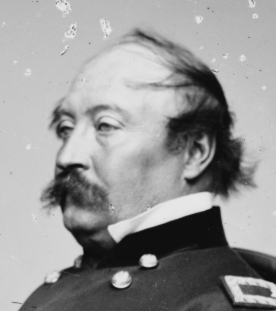
Position at Antietam
Commander, 3rd Division, Second Corps, Army of the Potomac (Age 41 at the battle)
Personal
1821-1889 Maryland
Nickname: “Old Blinkey”
Born in Baltimore, Maryland. Son of William French, a merchant, later an employee of the Post Office. Married Caroline Reed DuBose in 1830. Four sons, all military officers: Frank, 1st Artillery, U.S. Army; William, 57th NY; Frederick, West Point grad, 1877; George, U.S. Navy; and daughter, Annie
Education
West Point Class of 1837, ranked 22nd of 50. Classmates: Braxton Bragg, Jubal Early, John Sedgwick, and Joseph Hooker. Commissioned in 1st Artillery.
Mexican War
First Lieutenant in 1st Artillery; two brevets for gallantry Cerro Gordo and Contreras and Churubusco. Served in light artillery batteries.
Other military career highlights
“Stonewall” Jackson served as a lieutenant in French’s company in Florida after the Mexican war. They did not get along and Jackson eventually resigned. Along with Henry Hunt and William Barry, co-authored Instruction for Field Artillery. Commanded a battalion of artillery in Texas when the
state succeeded, and supervised the withdrawal of the artillery companies from Texas.
Civilian career highlights
N/A
Civil War
Brigadier General U.S. Volunteers (USV), September 28, 1861; brigade commander in Richardson’s division during the Peninsula Campaign; Brevet for Fair Oaks; division commander 2nd Corps September 15, 1862; Brevet for Antietam; Major General USV, November 29, 1862; led division at Fredericksburg and Chancellorsville; Brevet brigadier general U.S. Army for Chancellorsville. Command at Harpers Ferry during the Gettysburg Campaign. Commander, Third Corps from July 7, 1863 through the Brandy station and Mine Run battles. Mustered out of volunteers May 6, 1864. Chief of Artillery, Middle Department, January to May 1865. Brevet Major General U.S. Army for services during the war. His son Frank French served as an artillery officer during the war. Frank was seriously wounded at Ball’s Bluff in October, 1861, and died of pneumonia in 1865.
Postwar
Returned to the artillery as Lieutenant Colonel, Second Artillery; Colonel, Fourth Artillery, July 2, 1877. Retired July 1, 1880.
Death
May 20, 1881 in Washington D.C., age of 66.
Quotes
“A mind of unusual quickness, well, replenished by a long experience in his profession. (French) was able to take more men into action, and have less stragglers than any of his parallel commanders.” Oliver Howard
“A large man with a red nose, a flushed face, a bald forehead, a dull look. Near him, a glass of whiskey appeared to be on the table en permanence.” Philip Regis de Trobriand
“So repulsive an appearance as to invite nausea at the sight of his bloated and discolored visage. A perfect old soaker. A devotee of lust and appetite, the meanest looking general I have ever seen.” John Haley, Maine volunteer
“Its failure was no doubt, mainly owing to General French, who, I find is generally believed, was drunk. I cannot vouch for the truth of this, however, and hope it was not so. He certainly lost his way twice, and appears to have acted very queerly.” Charles Wainwright, describing French’s actions at Mine Run, Nov 1863.
“Plethoric, stout… red in the face… martial not to say fierce.” Theodore Lyman
“I do not recall that General French was criticized in any way. And have always thought his division was well-managed and urged forward with great energy.” Samuel Sumner (son and aide to Major General Edwin Vose Sumner)