
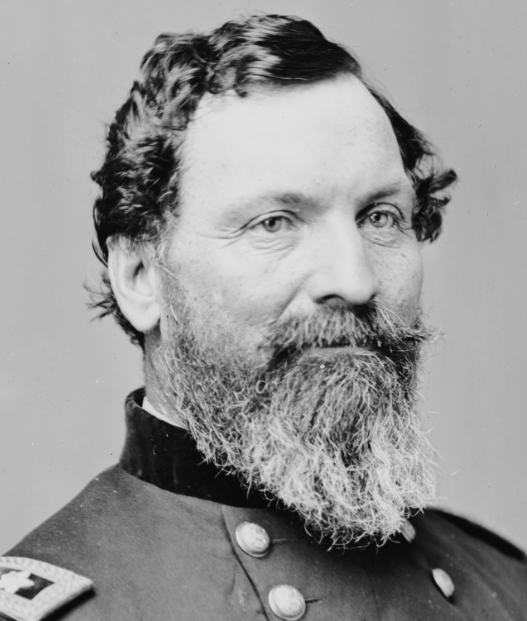
Position at Antietam
Commander, Second Division, Second Corps, Army of the Potomac (Age 49 at the battle)
Personal
1813-1864 Connecticut
Nickname: Uncle John
Born in Litchfield, CT; Unmarried
Education
West Point Class of 1837, ranked 24th of 50; Classmates: Braxton Bragg, Jubal Early, William French, and Joe Hooker. Commissioned in the Second Artillery.
Mexican War
First Lieutenant in the Second Artillery; two brevets for gallantry at Churubusco and Chapultepec
Other military career highlights
Fought in Second Seminole War, 1837-1838; After Mexican War promoted to Captain, 1849; Major, Second Cavalry, 1855; in Kansas Disturbances, Mormon War, Kiowa and Comanche Expeditions, 1860; Promoted to Colonel, First Cavalry in April 1861, succeeding Robert E. Lee.
Civilian career highlights
N/A
Civil War
At the start of the war, Sedgwick was serving as a colonel and assistant inspector general of the Military Department of Washington. Missed First Bull Run recovering from cholera; promoted to brigadier general Aug 31, 1861; commander of a brigade and then Second Division, Second Corps on the Peninsula; fought at Yorktown, Williamsburg, Seven Pines, Savage Station and Glendale. Not involved in Second Manassas Campaign. Commanded division at Antietam, seriously wounded in leg, wrist and shoulder and missed Fredericksburg. Commanded the troops that stormed Marye’s Heights at Chancellorsville and commanded his corps on the Gettysburg (corps was the last to arrive and did not see much action) and Rapidan Campaigns. Commanded Fifth and Sixth Corps at Rappahannock Station, Nov 7, 1863 and Mine Run, Nov 26-Dec 3, 1863. Commanded Sixth Corps in the Wilderness, May 5-6, 1864.
Postwar
N/A
Death
Killed by a sharpshooter at the Battle of Spotsylvania, May 9, 1864, age 50; one of the highest-ranking Union soldiers to be killed in the war. Last words: “They couldn’t hit an elephant at this distance.”
Quotes
“He was one of the best and most modest soldiers we had. Possessing excellent ability and judgement, the highest bravery, great skill in handling troops, wonderful powers in instructing and disciplining men, as well as in gaining their love, respect and confidence, he was withal so modest and unobtrusive, that it was necessary to be thrown closely in contact with him to appreciate him. He was thoroughly unselfish, honest, and true as steel.” George B. McClellan
“He felt he could do better service with the troops which he knew, and which knew him. Colonel Coburn about Sedgwick declining to accept command of the Twelfth Corps in the Maryland Campaign
“Sedgwick was essentially a soldier. He had never married; the camp was his home and the members of his staff were his family. He was always spoken of familiarly as Uncle John.” Horace Porter
“He was among the good and brave generals, though not of the class of dashing officers, and was ever reliable and persistent.” Gideon Welles
“A good honest fellow and that is all.” Marsena Patrick
“If I am ever hit again, I hope it will settle me at once. I want no more wounds.” Sedgwick in early 1863 discussing his wounding at Antietam. He was killed by a sharpshooter at Spotsylvania on May 9, 1864.
“He stood very high with the army…as an officer and a man. He was brave and conscientious. His ambition was not great, and he seemed to dread responsibility. He was willing to do any amount of battling, but always wanted someone else to direct.”
U.S. Grant
“One could not help admiring the gallant, stupid old soldier, for no one ever looked more heroic than did he at the head of his troops in the heat of battle. His presence and bearing with troops, made your ideal of a perfect soldier.” Charles Whittier, “An Egotistical Memoir,” typescript, Boston Public Library
“He was a most excellent corps commander, studious of every detail. I never knew a commander who so studied, analyzed and remembered the morning reports. I can recall with delight the wild cheers which went up to him from the splendid Vermont brigade when they returned to him after detached service of a day, in which they had sustained terrible losses. These soldiers acted as if they had come home out of the storm to a loving and careful father.” Charles Whittier one of Sedgwick’s staff