
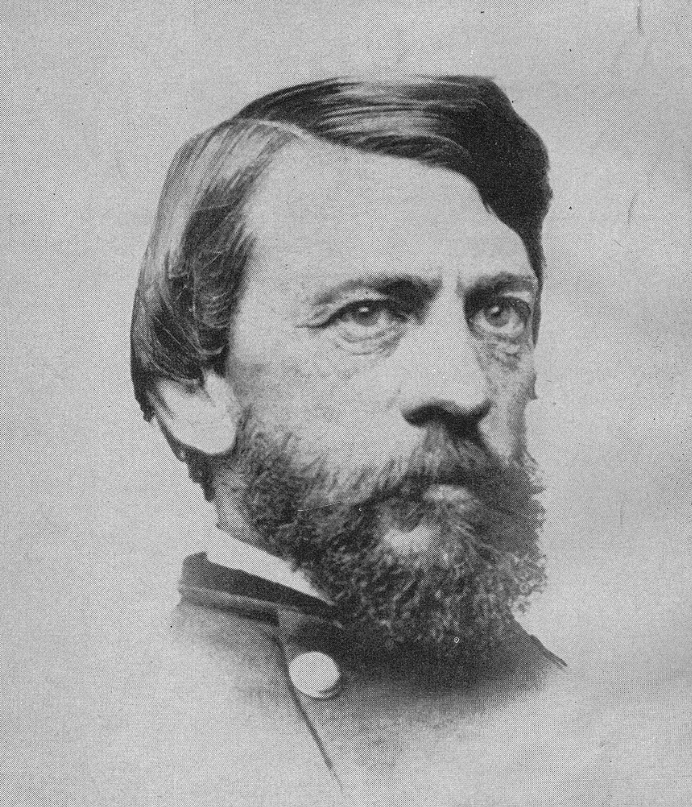
Position at Antietam
Medical Director, Army of the Potomac (Age 37 at the battle)
Personal
1824-1872 Pennsylvania
Nickname: Known as “Father of Modern Battlefield Medicine”
Born in Canonsburg, PA, Dec 11, 1824. Father was a surgeon. Married Mary Lee in October 1863.
Education
Graduated from Jefferson College in 1845 and Jefferson Medical College in 1849.
Mexican War
N/A
Other military career highlights
Assumed rank of Assistant Surgeon in the Army Medical Department in 1849. Served in various campaigns against Native American tribes in Florida, Minnesota, New Mexico and California.
Civilian career highlights
N/A
Civil War
June 1862, appointed Medical Director of the Army of the Potomac with the rank of major. After serving for a brief period as inspector of hospitals, Letterman resigned from the army in December, 1864
Postwar
Moved to San Francisco where he served as coroner and published his memoirs, Medical Recollections of the Army of the Potomac.
Death
In 1867, after the death of his wife, Letterman became severely depressed. Several illnesses followed and on March 15, 1872 he passed away. He is buried in Arlington National Cemetery. Age 48
Quotes
““In making this assignment, I have been governed by what I conceive to be the best interests of the service. Your energy, determination, and faithful discharge of duty in all the different situations in which you have been placed during your service of 13 years, determined me to place you in the most arduous, responsible and trying position you have yet occupied. And now, trusting to your possession of those qualities, without which I should never have assigned you to the duty, I commit to you the health, the comfort, and the lives of thousands of our fellow soldiers who are fighting for the maintenance of their liberties. Army Surgeon General W.A. Hammond in his letter appointing Letterman as Medical Director of the Army of the Potomac on June 19, 1862
“Too much praise cannot be awarded to Dr. Letterman for the patient and intelligence zeal with which he has labored to establish and perfect the present organization of the medical service of the army of the Potomac. Its conception can only occur to a mind apt in method and organization, and while of comprehensive grasp, yet trained by experience to the study of details. To Dr. Letterman is due the gratitude of the country for his perseverance, and effecting these desired reforms.” New York Medical Journal 1864
“I knew nothing of it until it was done. It was a position I did not seek; it was one I could not decline. In a private letter, Letterman discussed the circumstances surrounding his appointment as Medical Director of the Army of the Potomac. Memoir of Jonathan Letterman by Bennett Clements, Journal of the Military Service Institution, Vol. IV, No. 15, September 1883, page 23.
“I always had reasons to be thankful that we were favored by a gentleman of such equable temperament, and such skill in his profession. I never knew an officer who was all the time more ready to act out the call of duty; full of manly sympathy, he was ever ready to render timely aid to the suffering, whether at the summons of an officer, or the call of a private soldier. William F. Loring (eventually appointed a Confederate general), recalling his service with Letterman at Fort Union, New Mexico, in the 1850s
“It recalled in all its freshness the memory of those trying days during which it was my good fortune to have him at my side as the Chief Medical Officer of the Army of the Potomac. I saw immediately that Letterman was the man for the occasion, and at once gave him my unbounded confidence. In our long and frequent interviews upon the subject of his duties I was most strongly impressed by his accurate knowledge of his work, the clear and perfectly practical nature of his views and the thorough unselfishness of his character. I never met with his superior in power of organization and executive ability.” George B. McClellan February 26, 1883